Plans to import 4GW of low-carbon electricity by 2035 continue to make steadyprogress
The EMA is granting Conditional Approval to Sembcorp Utilities Pte Ltd (SCU),a wholly-owned subsidiary of Sembcorp Industries Ltd, to import 1.2GW of low carbonelectricity from Vietnam to Singapore. Based on SCU’s proposal, the importedelectricity will harness offshore wind power and potentially other forms of generation,to be developed with Petrovietnam Technical Services Corporation (PTSC). It will betransmitted from Vietnam to Singapore via new subsea cables that will span a distanceof around 1,000km.
2. The Conditional Approval recognises that the project is preliminarily assessedby EMA to be technically and commercially viable. It facilitates SCU in obtainingnecessary regulatory approvals and licences for the project. It also builds on theoffshore wind site survey permit approval and Letter of Intent issued to the SCU-PTSCConsortium by the Vietnam and Singapore governments respectively in August 2023.
3. The progress made on this project is a positive development arising from theMemorandum of Understanding (MOU) on Energy Cooperation between Vietnam andSingapore, signed in October 2022, which reaffirmed both countries' commitment tosupport and facilitate clean energy transition efforts and regional decarbonisation,including greater cross-border electricity trading.
4. On 25 October 2021, Minister for Trade and Industry Gan Kim Yong announcedSingapore’s plans to import up to 4 GW of low-carbon electricity by 2035. To date,EMA has granted Conditional Approvals to projects from various sources, comprising2 GW from Indonesia, 1 GW from Cambodia and 1.2 GW from Vietnam.If realised, these projects will collectively tap on a diverse mix of solar energy, hydropower, andwind power.
5. To ensure reliability of supply, EMA has been working with importers to put inplace sufficient safeguards against any prolonged supply disruptions. EMA will alsocontinue to explore low-carbon alternatives such as geothermal, hydrogen andtechnologies such as carbon capture and storage to ensure that the power systemremains secure, reliable and sustainable.
Annex A: Information on the Singapore Energy Transition
Annex B: How Does the Request-for-Proposal Process Work?
-- END –
About the Energy Market Authority
The Energy Market Authority (EMA) is a statutory board under the Singapore Ministry of Trade and Industry. Through our work, we seek to build a clean energy future that is resilient, sustainable, and competitive. We aim to ensure a reliable and secure energy supply, promote effective competition in the energy market and develop a dynamic energy sector in Singapore. Visit www.ema.gov.sg for more information.
For media enquiries, please contact:
Ms Sikha Bagaria
Senior Manager, Corporate Communications
Energy Market Authority
Tel: (65) 9777 4790
Email: sikha_bagaria@ema.gov.sg
ANNEX A
ADVANCING SINGAPORE’S ENERGY TRANSITION TOWARDS A MORESUSTAINABLE FUTURE
Climate change is a global existential threat and Singapore is doing its part toreduce emissions for a more sustainable future. As announced by Minister for FinanceMr Lawrence Wong at Budget 2022, Singapore will raise our climate ambition toachieve net zero emissions by or around mid-century.
2. The power sector has a key part to play as it accounts for about 40% ofSingapore’s carbon emissions1. We need to significantly reduce the power sector’semissions, while ensuring that the power system remains secure, reliable, andsustainable. Singapore is therefore harnessing natural gas, solar, regional powergrids, and low-carbon alternatives to transform its energy supply, while promotingenergy efficiency to reduce demand. Electricity imports are illustrative of howSingapore is tapping on regional power grids to meet energy demand.
Regional Power Grids
3. To address Singapore's land constraints, the country is looking to regionalpower grids for clean energy sources. Regional power grids can accelerate renewableenergy development in the region and facilitate economic growth while diversifyingenergy sources away from fossil fuels.
4. By 2035, Singapore plans to import 4 GW of low-carbon electricity. The importswill be obtained through a competitive RFP process, while maintaining energy securityby diversifying import sources and ensuring backup supplies.
5. EMA is working with various partners on electricity import trials to refinetechnical and regulatory frameworks, including the Lao PDR-Thailand-Malaysia-Singapore Power Integration Project (LTMS-PIP) project importing up to 100 MW ofrenewable hydropower from Lao PDR to Singapore via Thailand and Malaysia.
ANNEX B
How does the Conditional Approval Process Work?
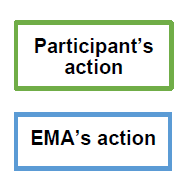
Below diagram outlines the steps involved in the provision of Conditional Approval.More details are available at https://go.gov.sg/imports-rfp.
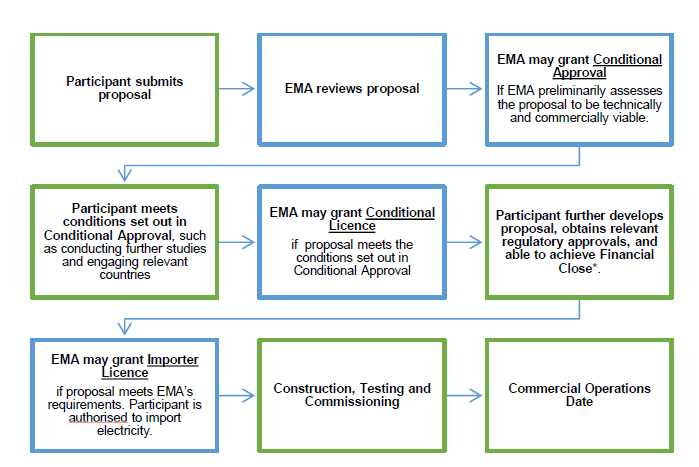
*Financial close refers to the stage at which all necessary financing for the project has beensecured, all conditions have been met, and all parties have signed the required documentationfor project developer to start drawing down the financing to fund the project.
Legend: