During the SIEW Thinktank Roundtable hosted by the Energy Research Institute @Nanyang Technological University (ERI@N), experts weighed in on how engagingconsumers can lead to smarter grids with demand side flexibility and targetdecarbonisation.
Mr Cherif Assaf, Programme Director at Energy Research Institute @ Nanyang Technological University (ERI@N), opened the roundtable discussion with the statement, “Customer is the focus of this workshop today. The customer is becoming by himself a microgrid.” and mentioned how the customer can support the grid and gain benefits in return. He also stated how engaging the consumers is in utility’s interest, as the utility can find the extra optimisation by managing the grid at the level of the customer and even achieve deferral of investment. This was followed by four keynote addresses on the various aspects, methods,benefits, and challenges of engaging the consumer.
Mr Assaf presented the first keynote on the role of consumers in the energy transition of Singapore, based on relevant facts and figures. He laid out the conceptual framework of various power system flexibilities and how demand side flexibility is becoming a major form of flexibility that is obtainable from a reimagined consumer who has more electrified consumptions, flexible loads, distributed energy resources such as photovoltaic generations, energy storage systems, electric vehicles, and multi-energy co-generations. Mr Assaf added that the consumer-assisted flexibility is accompanied by a new access model in which electrical assets might be shared and orchestrated. He showcased the efforts at ERI@N – Smart Multi-Energy System (SMES) and Distributed Energy Resource Management System (DERMS) projects – that can engage industrial customers individually and both industrial and commercial customers at the grid level.
Mr Peter Goh, Vice-President of Sunseap Group, introduced the wide array of services by which Sunseap is guiding building and facility owners in their transition to a low carbon future. This includes solar leasing, energy retail, clean energy retail, energy performance contracting, green roofs, environmentally sustainable design, energy storage systems, microgrids and smart EV charging solutions. He likened sustainability and decarbonisation to a “weight-loss journey”. He showed examples of floating PV, PV farm and rooftop PV installations, solar green roof, and provided examples of consumers engaged for energy retrofits that lead to significant savings.
Mr Goh commented, “Singapore has a very good and robust ecosystem today – from energy companies to banks providing green financing”, urging the attendees to investigate how their companies and organisations can play their part for the environment.
Mr Jean-Philippe El Khoury, Head of Sales of Schneider Electric for Smart Grid in East Asia, and Japan, presented on how to engage, activate, and orchestrate utility customers and their energy usage. He shared a solution from Uplight that is implemented by more than 80 utilities, mostly in North America, and implemented for more than 110 million customers. Mr El Khoury focused on improving customer experience through a digital platform called ‘Connect’. He stressed on personalising offers to the customers through disaggregation of data, knowing behaviour and by using weather services, and combinedly using these to perform energy optimisation. Smart thermostat operations and mobile app operations to drive consumption patterns were then illustrated. Mr El Khoury concluded that the platform can help utilities reduce their base load by changing customer behaviour and rolling out new programs for energy efficiency while reducing consumer’s electricity bills.
Ms Anne-Soizic Ranchere, Principal from Enea Consulting Singapore, stated, “Today, large corporates are taking the lead to advance on the energy transition. It is their objective to achieve climate target, improve resiliency, but as well as driven by economic objectives such as energy efficiency and low carbon generation that are increasingly competitive”. She proceeded further to explain the changing power system needs, the shift to decentralised and renewables with multiple small actors, the evolving trends in distributed energy resources, communication and control, and the enabling platforms. She also commented on the commercial, technical, regulatory, and social barriers, and the new value propositions for consumers, energy retailers, ESCOs, grid and financing institutions.
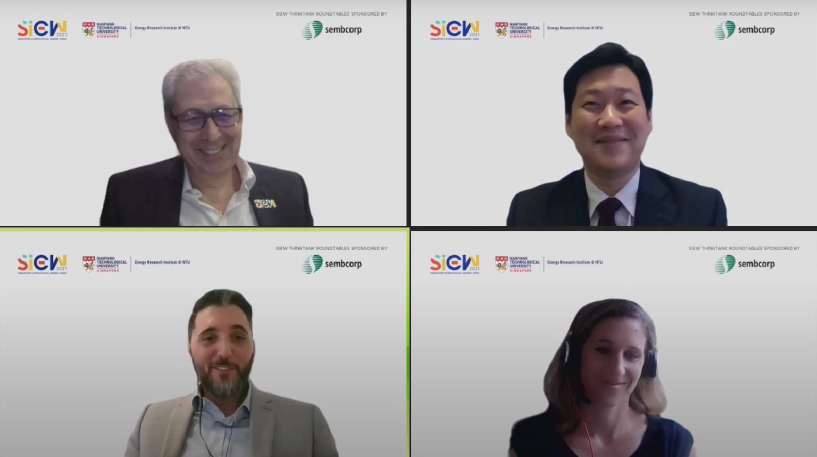
Two panel discussions were moderated by Mr Assaf – one that involved Q&A with Mr Peter Goh, and another which involved all the speakers. A few comments from those discussions are below.
- Mr Peter Goh remarked how the customers in Singapore and south-east Asia are cost-sensitive and it is important to justify the returns on the capital expenditures made. He also remarked that to decarbonise, the customer must know oneself first and how green they currently are through an energy audit.
- The panel concurred on the immediate commercial nonviability of energy storage as a service model in Singapore. Mr Goh commented on the technology reality of Lithium-ion batteries and how they are still cost prohibitive for certain purposes. But he remarked that charging batteries using solar panels might work. Ms Ranchere hinted that a new forward capacity market can provide additional revenue from storage.
- On consumer engagement using digital platform, Mr El Khoury commented that technology already exists but not all pre-conditions are fully available yet in Asia or Singapore, however with a push of regulation they can be deployed. The extent of benefit to utility depends on how many customers are engaged and what the consumers use.
- Ms Ranchere remarked on the modular approaches in Western Australia by having stand-alone power systems but stated that meshed grid is better for higher population density and demand side flexibility can be utilised through dynamic connection agreements for all types of energy assets. Moreover, flexibility on the thermal side and electrical side can be taken together.
The roundtable concluded with final remarks from the speakers on the need for innovation, new business models, the need for consumers to take full advantage of the ecosystem in Singapore, and the need for combined effort to reach a much more sustainable future.
Watch the full 2021 SIEW Thinktank Roundtable session on-demand here for more insights. Sign up to receive alerts on future SIEW events.