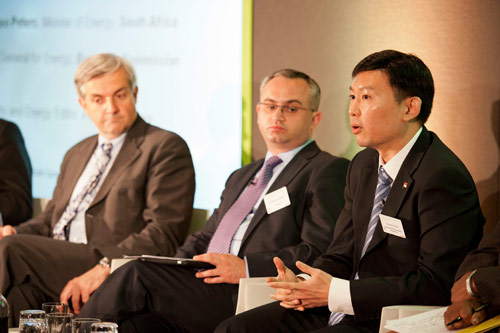
EMA CE Chee Hong Tat (right) shares how policies are key to shaping the new energy landscape, during the FT Global Energy Leaders Summit in the UK. (Photo credit: Richard Hill)
The new gas dynamics and recent oil troubles in the Middle East and North Africa, as well nuclear crisis in Fukushima, Japan, have shaken the global energy landscape like never before. How does the world secure its energy future in the midst of such upheaval"font-family: arial,helvetica,sans-serif;">At the two-day FT Global Energy Leaders Summit, held 28-29 July in the UK, the Energy Market Authority's (EMA) own Chief Executive, Mr Chee Hong Tat, was among members of government and industry leaders addressing top-line challenges such as the new energy paradigm and future energy mix and policy responses.
Mr Chee, who was part of the high-level policy session of this year's Summit, themed "Policy Forum: Shaping the Energy Future", spoke at length on Singapore's multi-pronged approach to securing its energy future.
He began by providing an overview of Singapore and alluding to parallels with the UK in terms of the energy trilemma of cost competitiveness, energy security and environmental sustainability. In light of this, he offered two key policy pointers to navigating the new energy future. First of these would be to make full use of market forces and to apply sound economic principles. This would mean pricing energy properly and avoiding subsidies so that consumers are subject to the right incentives. The government's role would be to provide the necessary guidelines, as well as to invest in energy research and innovation.
For instance, he explained that Singapore had invested considerably in the area of clean energy research as the city-state recognised that technology is a key enabler in powering a low-carbon future. Its small carbon footprint notwithstanding, Singapore aims to be a "living laboratory" for companies seeking to test-bed their technologies for subsequent full-scale deployment.
The second point that the EMA Chief Executive raised was the need for governments to facilitate international dialogue at all levels with regional neighbours, as well as with international organisations such as the International Energy Agency (IEA).
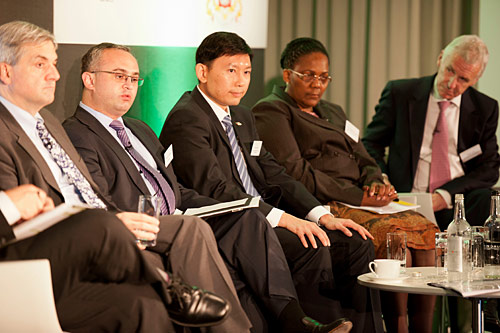
EMA CE, Mr Chee (middle), is joined by panellists (from left to right) The Rt Hon Chris Huhne, MP, Secretary of State for Energy and Climate Change, UK; Mr Alexander Khetaguri , Minister of Energy and Natural Resources, Georgia; The Hon Elizabeth Dipuo Peters (second on right), Minister of Energy for South Africa; and Mr Philip Lowe, Director General for Energy, European Commission. (Photo credit: Richard Hill)
No single country, he said, would have all the solutions to tackle the energy and climate challenges that confront the world. Mr Chee reiterated that it was therefore important that countries work together to strengthen the framework for energy cooperation, sharing experiences and expertise in areas such as energy efficiency, common transmission and distribution infrastructure, among others.
This was Mr Chee's first official speaking engagement overseas as CE of the EMA, and his perspectives on Singapore, policy development and the energy landscape were well-received by an audience of 150 energy professionals.