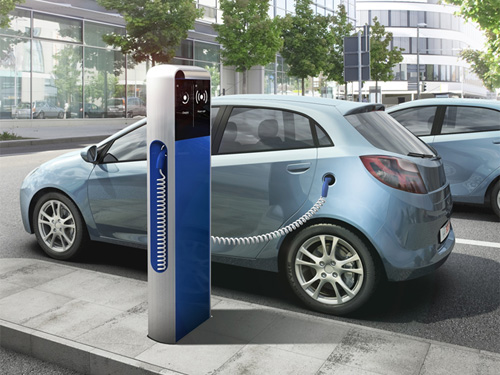
(Photo credit: Bosch)
We are living in the new millennium and have already made huge technological strides. But have you stopped to think what the future holds.
What the future could hold
All over the world, there is a surge in the number of vehicles plying the roads. This increase has given rise to environmental, political and security concerns. Air pollution, traffic jams and climate change are topics much discussed these days, and in response, there has been greater interest in renewable energy as a clean source of power. That said, the global carbon footprint is still rising as greenhouse gas emissions from transport remains a key, albeit avoidable, challenge for governments to tackle.
"Today, there are an estimated 800 million motor vehicles on the road worldwide, with this number expected to triple by 2050." -- Mr Choy Kin Man, Assistant Vice President, Industry - Automotive, TUV SUD PSB Pte Ltd (2010)
"The launch of the EV charging infrastructure marks an important milestone for our test-bed. We look forward to working with Bosch to roll out the charging infrastructure in Singapore as the first charging service provider appointed for the EV test-bed." -- Mr Yap Chin Siang, then Co-Chair, EV Taskforce
Like any other country, Singapore is experiencing increasing pressure to do something about the rising surge in population and vehicles. According to the National Climate Change Strategy report, transportation accounted for 19 percent of the city-state's total carbon emissions in 2005. Cognisant of that fact, Singapore authorities started to assess transportation trends globally and introduced an Electric Vehicle (EV) test-bed with several charging stations and full-electric cars on 25 June 2011. The aim would be to evaluate and gauge different EV prototypes and charging technologies within the city-state's urbanised environment and road conditions.
Approach
Since 2001, the government has put in place a Green Vehicle Rebate (GVR) scheme to boost the uptake of green vehicles. To encourage the research and development (R&D) of environmentally-friendly vehicle technologies, car companies can register vehicles used for R&D activities under the enhanced Transport Technology Innovation and Development Scheme (TIDES-PLUS), jointly administered by the Land Transport Authority (LTA) and the Economic Development Board (EDB). Other than these initiatives, an EV Taskforce was set up, led by the Energy Market Authority (EMA) and LTA, to develop and roll out the EV test-bed.
In 2010, Robert Bosch (South East Asia) Pte Ltd won a competitive bid to implement an integrated electric vehicle charging infrastructure for the Singapore EV test-bed. The challenge of an integrated charging infrastructure was to use a flexible open architecture to support interoperability among the players in the electric vehicle arena to ensure an integrated and seamless service to end users.
Challenges and solutions
For electric vehicles to take off, there are several challenges which need to be solved at the policy and infrastructure level. In the Singapore EV test-bed, the government has implemented initiatives on the policy level such as rebates for green vehicles and the TIDES-PLUS scheme, among others. Equally on the infrastructure end, the following problems have to be solved, such as:
- The driving range of the electric vehicles
- Car availability
- The interoperability and possibility of roaming to make electromobility available for everybody
Key to the test-bed's success is access to the charging infrastructure. Assuming that there will be more charging stations being installed at residences and commercial sites over the next few years, would the availability of charging stations be enough to ensure that such an initiative prospers.
Five EV charging stations in initial rollout
Charging infrastructure
The EV taskforce under EMA has announced the launch of five EV charging stations as part of the first phase rollout. These are currently located at the carparks of LTA, Ministry of Manpower, as well as at Bosch's Southeast Asia headquarters in Bishan. The Bosch outdoor charging stations allow two EVs to be charged simultaneously, while the indoor charging station powers one EV at a time. As part of the initial phase of the EV test-bed project, up to 63 charging stations are planned island-wide.
Software engine for integrated service approach
The solution is based on the Visual Rules software, which allows users to independently define and modify business rules. The software also makes it possible for other companies to integrate their business models into the eMobility Solution. Those companies may include operators of parking garages or facility managers, for example. The solution can be adapted to existing information and energy networks, allowing an e-mobility network to be tailored to the existing infrastructure in a given city.
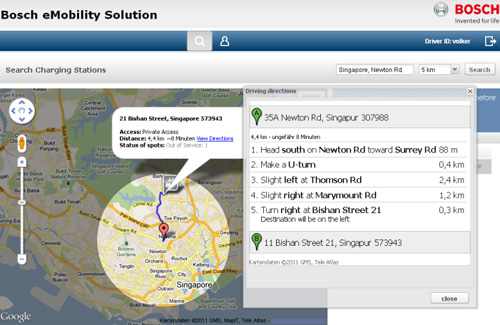
(Photo credit: Bosch)
The service platform is specifically designed to be open enough to allow competing companies--public utilities, for instance--to participate as well. In a next step, other providers will get a chance to integrate their charge spots within the service platform. The approach deliberately encourages unrestricted competition for creative ideas relating to e-mobility. It is accessible and flexible, offering customers a broad range of services and a high level of information security at the same time.
The software also allows every customer to manage account information, to search for the closest charging station, to keep track of charging activities, and even to pay bills. There is also a 24/7 customer service hotline to provide convenience for the customer. Future developments will include a Smartphone app.

Anuj Jain is Managing Director at Bosch Software Innovations, a Bosch Group Company. Bosch Software Innovations is a leader in providing integrated solutions for Internet of Things and Services. Bosch was selected by Singapore authorities to implement the EV test bed project recently launched in Singapore. Bosch's 'eMobility Solution' – electric vehicle charging platform - was also recognized with the prestigious Merlin award by The German American Chamber of Commerce in best innovator category for 2011.
By : Anuj Jain, Bosch