(Picture Credit: EMA)
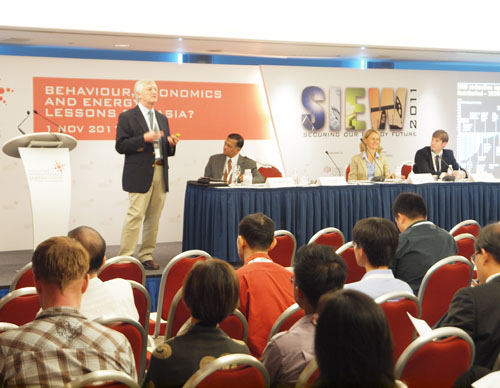
Behavioural economics is an increasingly popular branch of economics that incorporates elements from psychology to explain why people make seemingly irrational decisions--such as buying energy-inefficient light bulbs and appliances. Increasingly used to formulate energy policy, behavioural economics was the focus of a Roundtable organised by the Energy Studies Institute at the Singapore International Energy Week on 1 November 2011.
When there is poor information on price and energy use
Behavioural issues and market failures, according to Professor James Sweeney, Director of the Precourt Energy Efficiency Centre at Stanford University, prevail when there is poor information on price and energy use. Typically, consumers are only aware of their consumption of electricity through the use of electrical appliances, but do not have information on electricity price at the "point of purchase". Thus, the consumer tends to make suboptimal energy decisions.
Comparing this to grocery shopping without price tags on individual food items but only a monthly grocery bill, Prof Sweeney explained that such a system made it difficult for the consumer to make an optimal decision. Even when items were priced individually, calculating energy use requires considerable cognitive efforts and thus tends not to happen spontaneously during decision-making. In addition, when the cost of energy is a small percentage of a person's disposable income, the effort to use energy efficiently becomes a low priority.
Traditionally, policymakers have tended to rely on mainstream economic principles in energy policy formulation. With the increasing amount of evidence pointing to "irrational" decision-making in humans, all three speakers agreed that behavioural economics will complement the mainstream principles in policymaking.
A case of irrationality"irrationality" as a nudge to accomplish what we want to accomplish. Professor Dr Lucia A Reisch, Professor and Chair for Intercultural Behaviour and Consumer Policy at the Copenhagen Business School, added that behavioural economics has the potential of removing useless regulations, leading to more optimal decision-making.
Referring to the relationship between behavioural economics and energy consumption, Dr Kenneth Gillingham, Assistant Professor of Economics at Yale University, gave the example of how owner-occupied dwellings are 20 percent more likely to be insulated than renter-occupied, illustrating the presence of a principle-agent problem.
Green envy
He added that energy consumption is also affected by social norms such as peer effects. For example, a 1 percent increase in solar PV installed in a neighbourhood would lead to a 1 percent increase in likelihood that other residents in the same neighbourhood would install solar PV--a phenomenon Dr Gillingham described as "green envy".
Agreeing, Prof Sweeney said he had a similar experience at Stanford University, where a solar PV installation programme spurred 15 percent of the population to install solar panels despite it being a non-rational economic decision.
Regardless of the clear case for behavioural economics, Prof Sweeney cautioned that energy policy formulation is not a single issue problem and solutions should be multidimensional. In summary, behavioural economics is best thought of as a complement rather than a substitute to mainstream economic approaches to energy policy formulation.
BY : Belinda Salim and Catrina Yeo, Energy Studies Institute