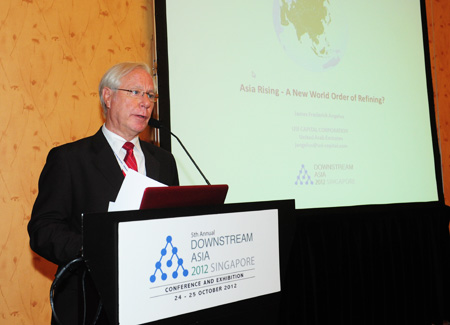
(Picture Credit: EMA)
"Asia rising" has taken many of the established refiners in Europe and North America by surprise, James Angelus, President, USI Capital Corporation told Downstream Asia 2012.
Angelus also spoke, however, of the challenges faced by Asia as it strives to develop major oil refinery hubs.
One challenge he raised is the potential market distortion as governments in Asia are more likely to subsidise fuel. He said this puts undue pressure on supply, and that market forces without government intervention would better determine outcomes.
Furthermore, he said the rise of Asian refinery hubs is being led by national oil companies and not--as has happened historically--by private companies. Yet the technologies driving the growth of the industry are still developed by private companies.
Angelus believes this makes it vital for governments to adopt free market principles.
One key issue with implications for Asia's development as a refinery hub is the region's geopolitics and the potential to create conflicts, which will impede the region's capacity to build. Citing Russia and China, Angelus commented that disagreements between the two countries have prevented connecting pipelines from being built, even though China may be well supplied by Russian oil and gas. More generally, the inability of countries to come together to develop hydrocarbon resources is a major impediment to Asia's growth as a refinery hub. Angelus described the political struggle as a "handicap".
Even so, he believes "Asia has the most dynamic refinery industry"--and cited its geographical advantage amidst the world's shipping lanes, its network of pipelines to support the growth of the oil and gas industry, and its educated population.
"That is the future of this industry," noted Angelus, adding that getting the mix of public-private partnership right is the key to the continued rise of Asia in the oil refining sector.
By :Leow Rui Ping, EMA