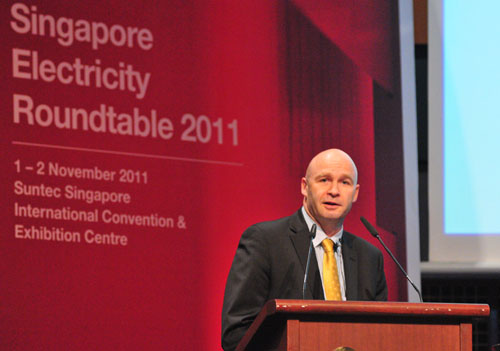
(Picture credit: EMA)
The New Zealand Electricity Authority was set up on 1 Nov 2010 as an independent Crown entity, with responsibility for the efficient operation of the New Zealand electricity market. The New Zealand electricity market shares many similarities with Singapore's market. Both have a small total electricity consumption of about 40,000GWh per year and vertically-integrated electricity systems. One key difference, however, is that New Zealand's electricity market has a lower growth rate.
Mr Carl Hansen, the Chief Executive of New Zealand's Electricity Authority, opened the Singapore Electricity Roundtable held from 1-2 November 2011 by sharing his insights on how the authority overcomes the challenges involved in building a competitive and reliable platform for electricity supply, trading and transmission in the country.
NZ electricity prices cheaper than others
Mr Hansen revealed that competition improved significantly after the liberalisation of the New Zealand market in 1999. That said, electricity prices had been on the increase since 2000, due to the rising cost of generation and lower gas reserves. Mr Hansen also acknowledged that there had been a higher frequency of price spikes and increased price volatility due to the volatility in international fuel prices. Still, electricity prices in New Zealand remain relatively cheap compared with international prices.
Referring to the customer switching campaign which the New Zealand Electricity Authority had introduced in June 2010, Mr Hansen noted that it successfully induced consumers to exercise their choices over suppliers and encouraged a proactive culture among end consumers.
Consumers in New Zealand can now switch suppliers within 3.5 days. In 2003, this could have taken as long as 200 days! There has also been significant cost savings reaped by end consumers as a result.
Mr Hansen also pointed to the hedge market, developed in 2010, as enhancing competition in the physical electricity market. According to a recent survey done on hedge market competitiveness, the number of respondents expressing confidence in the competitiveness of the New Zealand market reportedly doubled over that of 2005.
He was of the opinion that the hedge market has successfully increased contestability in the electricity market, enhanced security of supply and made the spot price more defendable at the top of the supply function. Examples of the hedge market's positive impact on the physical market include the facilitation of entry of independent generation companies and retailers, and the increased incentive for more industry participants to acquire and access information.
Finally, Mr Hansen shared that his Authority is looking into several new initiatives to further enhance competition and reliability, especially in relation to the hedge market. These include proactive market monitoring, financial transmission rights, scarcity pricing and new metering rules.
BY : Chua Shen Hwee, EMA staff