The SIEW Thinktank Roundtable: Surfing the Hydrogen Wave in Southeast Asia – Insights from Europe & Germany was hosted by Agora Energiewende, an international think tank specialised in energy transitions that develops evidence-based and politically viable strategies to advance the goal of climate neutrality across the globe. Ms Jesse Scott, Agora Energiewende’s Director of International Programmes chaired and moderated the discussions.
In setting the scene for the roundtable, Ms Scott highlighted that hydrogen as a very exciting topic today because of its key role in fulfilling net-zero climate targets. Energy systems will need to eventually adopt green hydrogen, i.e., hydrogen produced via renewable energy, as it represents a ‘missing link’ to decarbonise sectors, such as industry, where emissions reductions were thought to be challenging. As such, a ‘wave’ of national strategies designed to accelerate the growth of hydrogen strategies have been announced. Speakers from the first roundtable presented their perspectives on hydrogen strategies from Germany, Europe and Southeast Asia.
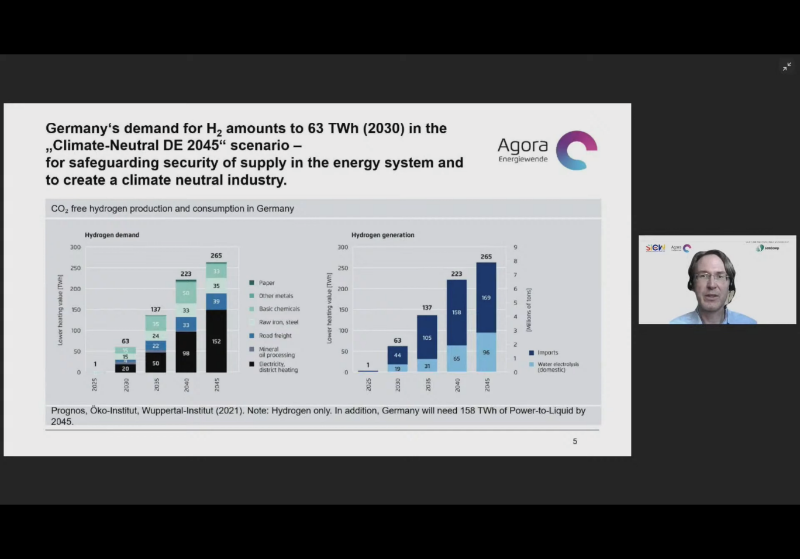
Dr Matthias Deutsch, Programme Lead for Hydrogen at Agora Energiewende, shared his thoughts on Germany‘s hydrogen strategy. Firstly, he highlighted that there are a limited set of applications that need hydrogen to become climate neutral and that policy frameworks should target initially target those no-regret applications such as in steel production, long-haul aviation or long-term storage to back up variable renewable energy. In Agora’s study on Climate Neutral Germany by 2045, an estimated 60 TWh low-carbon hydrogen and 10 GW of domestically installed electrolyser capacity are needed by 2030. Germany’s current Hydrogen strategy only targets 5 GW by 2030. Policy support will be required for both domestic and international projects as Germany will also rely on hydrogen imports to meet demand. In any case, Germany will need to increase its rate of renewable energy deployment to cover the future demand for domestic hydrogen production, on average around 10 GW solar and 5 GW wind per year.
Dr Gökçe Mete, Research Fellow at the Stockholm Environment Institute, presented on the future of hydrogen in the transition to net-zero in the European Union (EU). The EU Hydrogen Strategy, driven by both climate considerations and economic opportunities, sets a backbone for future policy making in the EU. The strategy includes, among others, an investment agenda as well as elements focusing on RD&D, creating markets, scaling infrastructure, and an alliance with non-state actors. The strategy is embedded within the bloc’s wider strategies, including, e.g., the EU economic recovery and fit-for-55 packages. European countries have targeted 6 GW of electrolyser installed capacity by 2024, rising to 40 GW by 2030. The EU prioritises similar sectors as in Germany, in steel and transport and to create innovation and transport networks. Dr Mete highlighted the work additional work across multiple sectors and policy packages needed to translate the strategy into an action plan. Finally, future growth in hydrogen will also create significant and diverse employment opportunities.
Mr Beni Suryadi, Manager of the Power Generation, Fossil Fuels, Alternative Energy and Energy Storage Department of ASEAN Centre for Energy, presented the key findings from the centre’s recently released report on Hydrogen in ASEAN. The study shows that the cost of hydrogen use in power and transport sectors is currently not economically viable. Looking at potential export markets to Japan, Korea and China the study found that the hydrogen produced from fossil fuels may already be competitive for the Japanese market, while green hydrogen might become competitive against fossil fuels by 2030. As such, ASEAN has outlined a regional policy roadmap to transform hydrogen from grey to green by 2030.
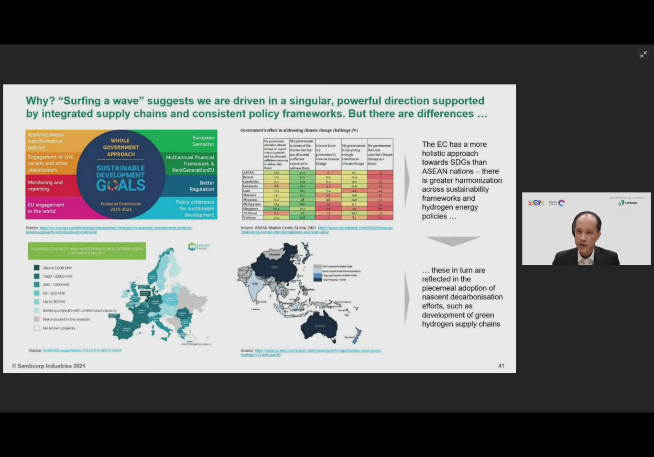
Mr Kenneth Kong, Senior Vice President of Group Strategy & Portfolio at Sembcorp, shared his perspectives from Sembcorp and Singapore on potential hydrogen application in southeast Asian markets. Mr Kong highlighted the differences between European and ASEAN situations and emphasized Europe’s more holistic approaches and integrated policy frameworks to the energy transition. Mr Kong also highlighted the differences in the upstream, downstream and midstream supply chains between the two regions, demonstrating divergent trends and that ASEAN nations are still very much at the nascent stages of their energy and hydrogen transitions. Mr Kong finished with a detailed examination of Singapore’s decarbonisation strategy and prospective uses for hydrogen.
The panel discussion moderated by Ms Scott of Agora Energiewende; the speakers shared their perspectives on the policy frameworks needed to enable the hydrogen transition:
Mr Kong and Mr Suryadi both highlighted the lessons that ASEAN nations could learn from Europe, including how to pursue a more integrated approach with other governments to see how they can work together to support national policy frameworks and give confidence to business and industry.
Mr Deutsch added that policy integration, regulation and standardisation would eventually need to extend completely down the value chain to include the uses and products produced using green hydrogen. Ms Mete spoke of the various global coordination and standardisation initiatives that are looking to create common language and clarity around hydrogen, including clear details on the embedded carbon in hydrogen production.
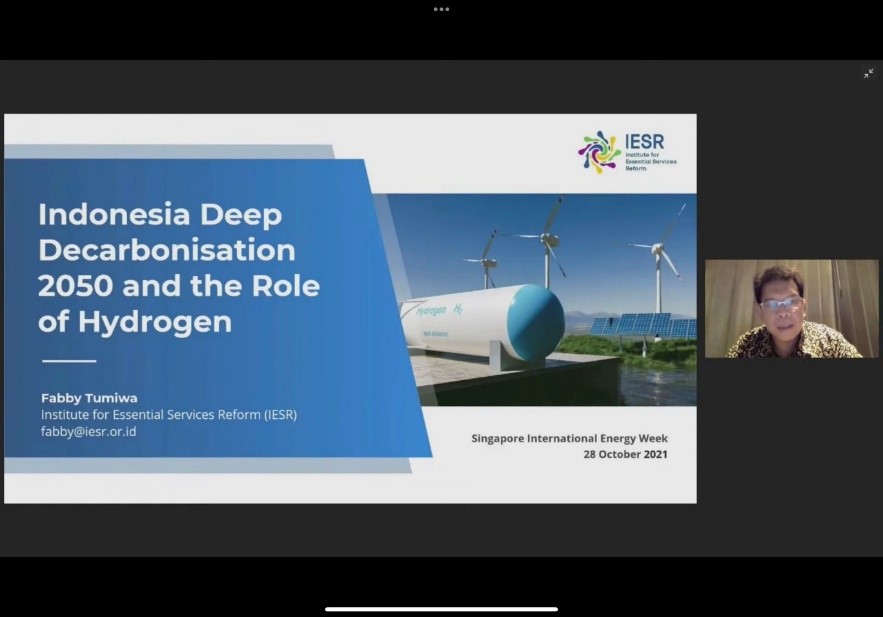
Mr Fabby Tumiwa, Executive Director of Institute for Essential Services Reform, shared key findings from IESR’s Indonesia Deep Decarbonisation 2050 study and explored the role of hydrogen in such an ambitious transition. Although the policy and regulatory support on hydrogen in Indonesia is unfortunately limited, private sector shows the high interest on hydrogen production.
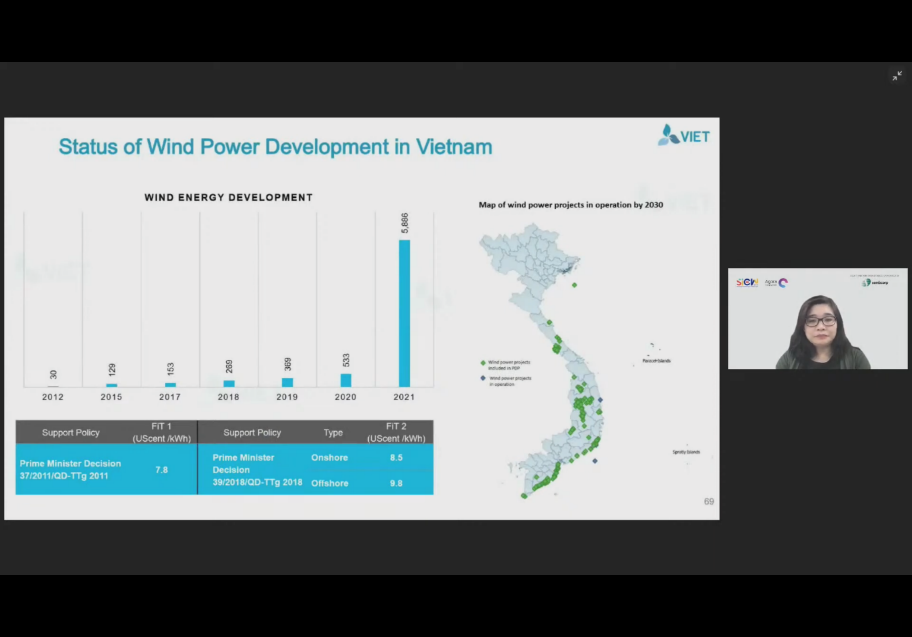
Ms Nhien Ngo, Executive Director of Vietnam Initiative for Energy Transition, presented the Hydrogen outlook for Vietnam. Vietnam is rich on variable renewable energy resources which indicates a strong potential for green hydrogen production. The country finds the energy transition in transport sector by replacing oil and gas with hydrogen, but the policy support is still required and is under development.
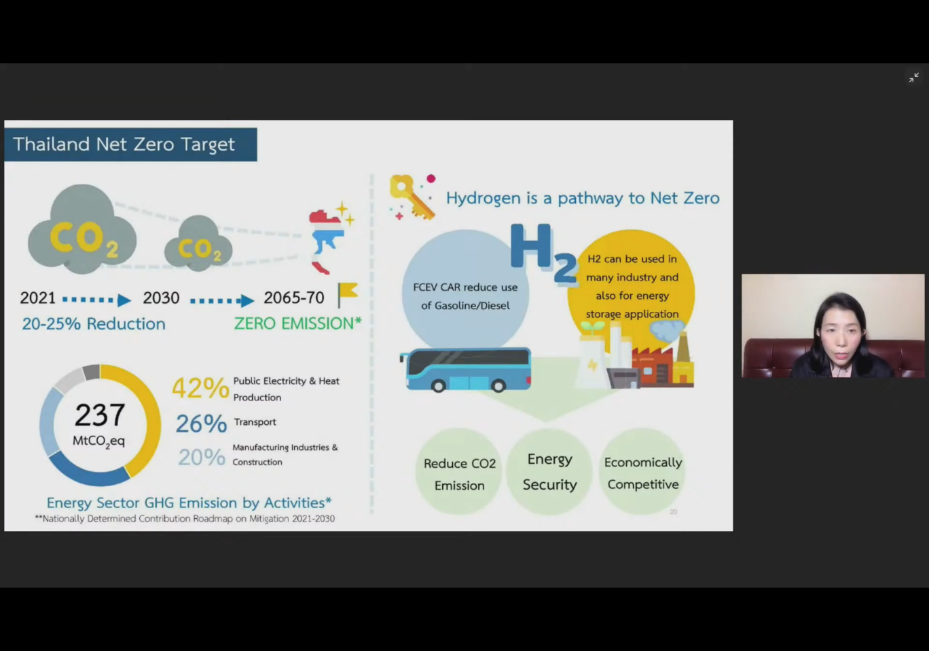
Dr Sumittra Charojrochkul, Energy Innovation Research Group Director of National Energy Technology Center Thailand, shared highlights from the Hydrogen Thailand Club. The club was founded in 2019, and includes members from government, utilities, research, industry and the private sector. The National Energy Plan is moving forward to develop the infrastructure and include hydrogen in transport sector to comply with the national carbon neutrality and net-zero targets.

During the second panel discussion, the speakers discussed what kinds of evidence would be needed to further support the development of hydrogen strategies and to unlock opportunities.
- Indonesia expects to have Ammonia from hydrogen production to replace the natural gas. The carbon price will make hydrogen cost competitive.
- Implementing Hydrogen in Thailand expects additional policy guidelines.
- Vietnam has the potential to become a hydrogen hub from its offshore wind resources, but only if the country is able to further develop its infrastructure and logistical services.
SIEW 2022 will be held on 24-28 October 2022! Save the date and sign up for updates on SIEW.