Insights at the Singapore-IRENA High-Level Forum and the shared vision of the speakers on achieving a sustainable energy future. Mian Rong Lee and Alika Koh report.
In a world confronting the pressing challenges of climate change and the energy transition, energy leaders gathered at the Singapore-International Renewable Energy Agency (IRENA) High-Level Forum to share their insights and commitment to a sustainable energy future. Three influential
Held on 24 October, this is the event's third edition, with this year's theme focusing on "Regional Interconnectivity for Net Zero".
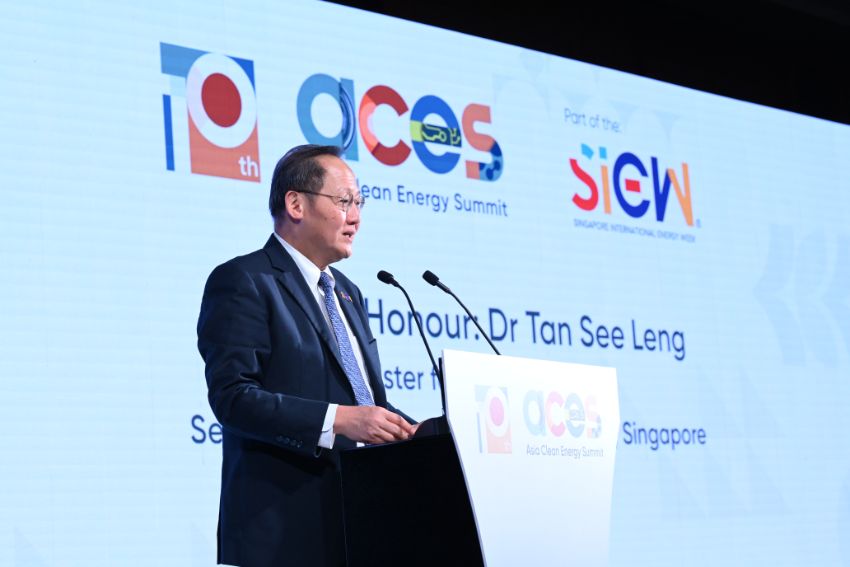
Dr Tan See Leng, Minister for Manpower and Second Minister for Trade and Industry; Francesco La Camera, Director-General for IRENA; and Christophe Inglin, Vice Chairman of the Sustainable Energy Association of Singapore (SEAS) and Managing Director of Energetix, delivered the Welcome Remarks and Opening Address. These three influential voices came together to underscore the significance of regional interconnectivity in Southeast Asia's journey towards a cleaner, greener energy landscape.
A shared vision of a sustainable future
Dr Tan opened the dialogue with a clarion call for regional interconnectivity, a pivotal element in Southeast Asia's journey towards net zero. While renewables and electricity become more accessible, global emissions continue to rise due to escalating energy demand. He emphasised that collective action is vital to curb global temperature increases.
He highlighted Southeast Asia's significant renewable energy potential and the transformative impact that regional interconnections can make in boosting investments, energy security, and growth. He said: "ASEAN has the potential to meet two-thirds of its energy demand with renewable energy and cut 75 percent of emissions by 2050." He also pointed out that regional interconnections can not only catalyse renewables deployment, but also generate savings of up to $160 billion through resource optimisation.
Dr Tan also shared Singapore's commitment to collaborative renewable energy projects. Recently, Singapore granted Conditional Approvals to import around 4GW of low carbon electricity from Cambodia, Indonesia, and Vietnam by 2035. Furthermore, the Phase 1 Singapore-US Feasibility Study on Regional Interconnectivity is nearing completion, which highlights that sub-sea interconnections will bring about environmental, security, and economic benefits. He stressed the indispensable role of legal, governance, and financing frameworks in this endeavour, emphasising that "working together collectively is no longer an option. It is a necessity".
Taking a private sector and investment focus
Mr La Camera emphasised the need to bridge investment gaps and enhance private-sector involvement to accelerate collaboration among IRENA member states. He highlighted the substantial investments required across energy systems, directed towards renewable power generation, grid infrastructure, electrification, and energy efficiency.
He also highlighted the critical role of the private sector in accelerating collaboration among IRENA member states. He stressed that enhancing the region's interconnectivity is the key to achieving the transition to net zero. "The time is now that we need to accelerate the rate of investment in energy transition,” he said. Such initiatives hold the promise of substantial financial and socioeconomic benefits for the region.
Innovations for a sustainable net zero future
Mr Inglin set the tone for an exploration of regional energy integration and cross-border infrastructure. He said: "Today we gather here to explore the intricate nexus of regional energy integration and cross border infrastructure. These discussions are not merely theoretical and aspirational; they represent concrete steps towards achieving the twin goals of energy security and sustainable net-zero future."
In saying this, he highlighted that addressing climate change and achieving a sustainable net zero future is a collective endeavour that requires regional cooperation and global partnerships.
He stressed the critical importance of cost-effectiveness in emerging wind and solar technologies, free from reliance on subsidies. Additionally, breakthroughs in energy storage, including advanced batteries and grid-scale solutions, further enhance energy reliability in the face of renewable energy fluctuations.
He commended the motor industry's decarbonisation efforts by shifting towards electric vehicles. Mr Inglin stressed that the development of low carbon fuels and carbon capture, utilisation and storage (CCUS) technologies are paramount in reducing energy waste and promoting good circular economy practices. He underlined the importance of strong policies and collaborative efforts in propelling innovations that will bring the world closer to achieving net zero targets.
Towards an interconnected world
The three speakers painted a collective vision of a highly interconnected and collaborative world. All three emphasised the importance of closing investment gaps for renewables, regional energy integration, and the development of emerging technologies as necessary steps to forging a path to a cleaner and more sustainable energy future.