By Jin Wang
As Asia works towards interconnected energy systems, effective implementation will require sustained cooperation between governments, regulators and industry to strengthen electricity reliability, affordability and long-term energy security.
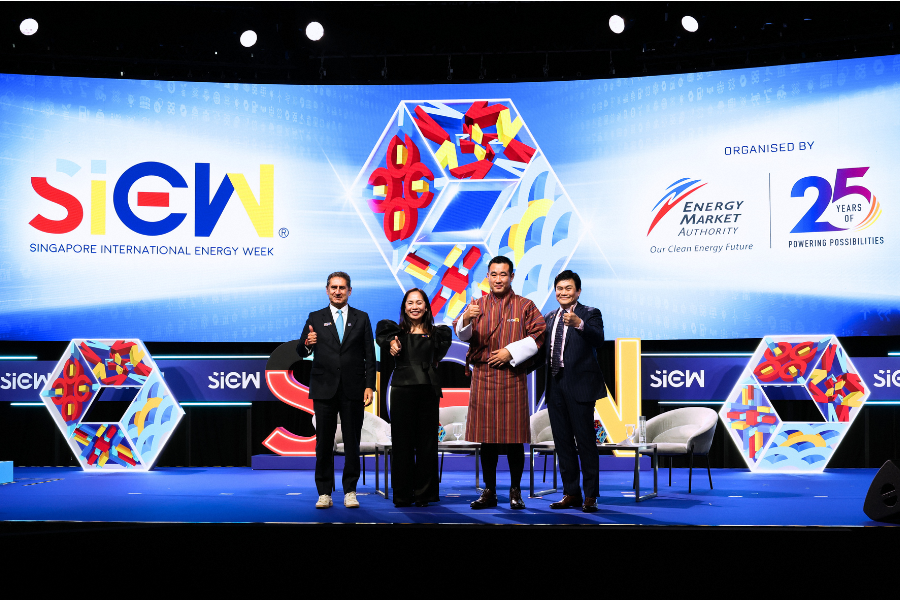
At the SIEW Ministerial Dialogue, senior representatives from the Philippines, Royal Government of Bhutan and the International Renewable Energy Agency (IRENA) discussed how countries can align national energy priorities with regional cooperation. Moderated by Roland Lim of CNA, the discussion explored the practical challenges of developing interconnected energy systems, from grid readiness and regulatory alignment to financing and renewable energy integration.
Infrastructure readiness is critical to renewables deployment
The Honourable Sharon S. Garin, Secretary, Department of Energy, Republic of the Philippines, highlighted the importance of coordinating infrastructure development alongside new renewable energy projects.
The Philippines is conducting its first offshore wind auction for 3,300 megawatts (MW) of fixed-bottom offshore wind capacity. This requires not only grid readiness but also suitable ports, community engagement and coordination across government agencies. Ms Garin explained that aligning infrastructure, regulations and stakeholder responsibilities early would help developers complete projects successfully and establish the foundations for subsequent offshore wind developments.
Balancing national priorities with shared benefits
H.E. Sonam Tashi, Minister of Energy and Natural Resources, Royal Government of Bhutan, outlined three principles underpinning successful energy cooperation: trust, shared value and alignment with national priorities.
Drawing on Bhutan's longstanding hydropower partnership with India, he emphasised the importance of sustained cooperation and mutually beneficial agreements. Bhutan's seasonal hydropower generation also presents challenges, with electricity exports increasing during summer and imports needed during winter.
Cross-border electricity trade depends on regulatory alignment and mutual advantage.
Ms Garin emphasised that advancing the ASEAN Power Grid requires both regional commitments and bilateral agreements between participating countries. She shared that ASEAN members had reached consensus on an enhanced Memorandum of Understanding (MOU), with finalisation anticipated at the leaders' meeting.
The Philippines is also pursuing discussions with Malaysia, Indonesia and Singapore on potential electricity interconnections. She highlighted the need for synchronised regulations and fair agreements that deliver benefits to participating countries, strengthening energy security at both national and regional levels.
Investment frameworks to support interconnected, affordable energy systems
Francesco La Camera, Director-General of IRENA, highlighted the growing importance of grid connectivity in strengthening resilience against energy supply disruptions.
Mr La Camera noted that renewable energy is increasingly competitive and can contribute to energy security through more diversified generation systems. However, expanding electricity supply requires investment in grids, storage and appropriate market structures. He also pointed to IRENA's findings that renewable energy combined with storage can offer a cost-competitive option for providing continuous electricity supply.
The dialogue highlighted that regional energy integration depends on aligning infrastructure development, national priorities and commercial interests. While countries face different resource constraints and energy needs, stronger partnerships and coordinated investment can help address shared challenges.
Under the proposed arrangement, Saudi crude oil would be stored at the Jurong Rock Caverns on Singapore’s Jurong Island. Storage operations are expected to commence in the second half of 2027. The stored crude oil will support Singapore’s energy needs in the event of a supply disruption, strengthening Singapore’s energy security and resilience. The arrangement will also enhance the resilience of the Saudi crude oil supply chain in Southeast Asia.
The proposed arrangement marks a new milestone in energy cooperation between Singapore and the Kingdom of Saudi Arabia. It also reflects the two countries’ shared commitment to strengthening regional energy security and recognises Singapore’s roles as a key regional energy hub.
Singapore’s Ministry of Energy, Trade and Industry and the Kingdom of Saudi Arabia’s Ministry of Energy will work closely to advance the arrangement and coordinate its implementation with relevant entities.
Stay tuned as the conversation evolves throughout the day. Follow @SIEW_sg on Telegram and X (formerly Twitter) for the latest insights.