By Sylvia Ho
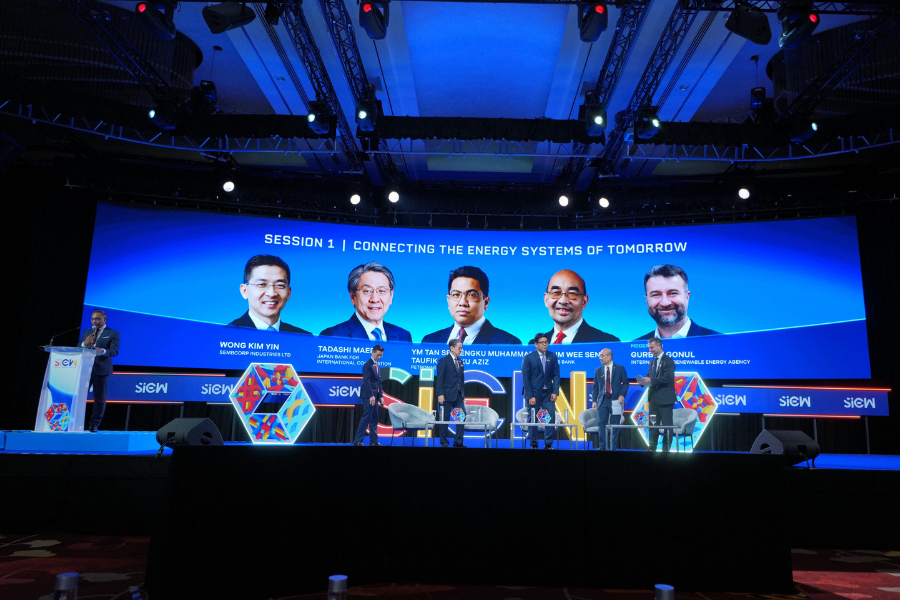
At SIEW Summit Session 1, “Connecting the Energy Systems of Tomorrow”, Gurbuz Gonul, Director, Country Engagement & Partnerships, International Renewable Energy Agency (IRENA), moderated a discussion on strengthening energy security, advancing the ASEAN Power Grid and encouraging investment for connected energy systems. Panellists examined how regional cooperation and investments can strengthen energy resilience while ensuring affordability.
Directing capital towards energy security
Lim Wee Seng, Group Head of Energy, Renewables & Infrastructure, Project Finance, Strategic Advisory and Sustainability, Institutional Banking Group, DBS Bank, shared that recent supply disruptions have redirected capital towards domestic fuel reserves, renewables, gas-fired generation and liquefied natural gas (LNG) infrastructure.
He emphasised that stronger domestic capabilities and regional interconnection are complementary responses to energy security risks. With electricity demand from artificial intelligence (AI) and data centres continuing to rise, investment in dispatchable generation will also be important as countries expand renewable energy capacity.
Tan Sri Tengku Muhammad Taufik Tengku Aziz, Chief Executive Officer, PETRONAS, emphasised the need to balance immediate energy security needs with longer-term decarbonisation goals. He advocated for a diversified energy mix that incorporates renewables while maintaining affordability.
Moving from financing commitments to project development
Tadashi Maeda, Chairman of the Board, Japan Bank for International Cooperation, highlighted the need to move beyond funding and agreements towards the practical development of energy projects.
He described Japan’s work with regional partners to bring together governments, financiers, utilities and technology providers, with solutions tailored to national circumstances and local legal and infrastructure requirements.
With countries starting from different positions, Mr Maeda stressed that financing, regulatory processes and technology deployment must advance together, rather than through a one-size-fits-all regional approach.
Connecting regional energy resources with demand centres
Wong Kim Yin, Group Chief Executive Officer, Sembcorp Industries Ltd, highlighted the ASEAN Power Grid's potential to connect Southeast Asia’s diverse energy resources with demand centres.
He cited Sembcorp’s conditional approval to import electricity from Vietnam through Malaysia into Singapore as an example of regional grid development.
However, he cautioned that equipment shortages, longer delivery times and competition for capital could increase costs and challenge affordability. While regional connectivity can create value by linking energy resources with demand, expanding supply options and building infrastructure redundancy also come at a cost.
Managing cross-border risks to attract private capital
Mr Wong also emphasised that attracting private capital depends on trust, aligned interests across borders and clear intergovernmental arrangements.
He noted that private insurers may be unable to cover risks associated with joint ownership of interconnectors, long-term payment arrangements and public-sector support. Political and credit risks also need to be addressed, with clear treaties and export permissions providing greater certainty for cross-border investments.
The discussion highlighted that regional energy connectivity depends on more than building physical infrastructure. Coordinated project development, clear regulatory arrangements and effective risk allocation will be essential to strengthen energy resilience and attract long-term investment.
Stay tuned as the conversation evolves throughout the day. Follow @SIEW_sg on Telegram and X (formerly Twitter) for the latest insights.