Nuclear energy could play a greater role in meeting Asia's growing electricity demand while supporting energy security and decarbonisation. Realising this potential will require more than technological advances. Countries will also need long-term planning, strong institutions and international cooperation.
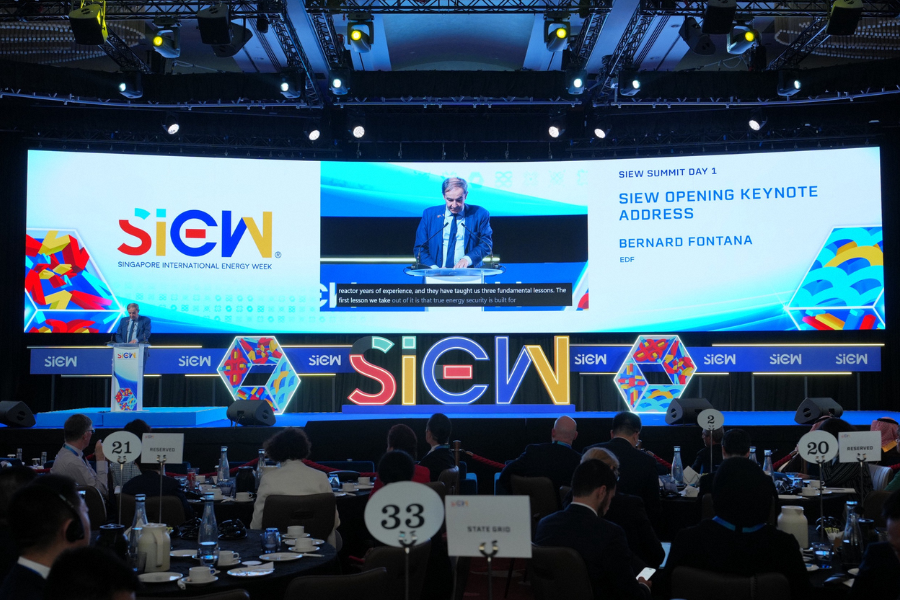
These were key messages from Bernard Fontana, Chief Executive Officer, EDF, and Rafael Mariano Grossi, Director General, International Atomic Energy Agency (IAEA), at the SIEW Opening Keynote Address at SIEW Summit Day 1.
France's nuclear experience highlights long-term planning
Mr Fontana from EDF explained how France's nuclear programme has helped reduce the country's dependence on imported fuels. Nuclear power accounted for around two-thirds of France's electricity generation in 2025.
Together with renewables, nuclear contributed to a power system in which approximately 95 percent of electricity generation was decarbonised. France recorded more than 90 terawatt-hours of net electricity exports in 2025.
He noted that nuclear power provides reliable electricity around the clock, complementing renewable sources such as wind and solar. Singapore is building its capabilities to assess the potential of nuclear energy. Mr Fontana noted that this work requires skilled professionals, independent regulation and public trust.
EDF is also preparing for a final investment decision by the end of November 2026 on a new programme with a planned generating capacity of 10 gigawatts. Mr Fontana said EDF's board decided in July to support its small modular reactor (SMR) programme.
Mr Fontana pointed to opportunities for ASEAN cooperation on nuclear safety standards, workforce development and industrial supply chains. Such partnerships could help the region make informed decisions about nuclear energy.
New technologies expand potential applications for nuclear
Mr Grossi from the IAEA observed that interest in nuclear energy is growing among governments, financial institutions and technology companies. Rising electricity demand, particularly from artificial intelligence (AI), is adding to this interest.
While conventional reactors will continue to play an important role, SMRs could serve a wider range of applications. These include industrial facilities, data centres, desalination and maritime transport.
The IAEA is working to address the regulatory challenges associated with these technologies. Mr Grossi cited its Atomic Technologies Licensed for Applications at Sea (ATLAS) initiative, launched in August. It brought together around 600 participants from more than 50 countries. The discussions covered legal, regulatory and policy issues surrounding maritime nuclear applications.
Building the foundations for responsible deployment
Nuclear energy development involves more than reactor technology. Drawing on France's experience, Mr Fontana highlighted the importance of long-term planning and national capabilities. Mr Grossi focused on the role of international cooperation. He explained how the IAEA helps countries assess nuclear technologies and prepare for their safe deployment.
The IAEA supports countries through peer reviews, training and frameworks for nuclear safety, security and safeguards. It is also working with the Asian Development Bank and World Bank Group to facilitate investment.
For Singapore and the wider region, building the expertise to evaluate nuclear power will become increasingly important as electricity demand grows. Strong institutions and informed decision-making can help each country determine what role, if any, nuclear power might play in its future energy mix.
Stay tuned as the conversation evolves throughout the day. Follow @SIEW_sg on Telegram and X (formerly Twitter) for the latest insights.