Asia's clean energy transition will require innovative ways to expand renewable energy deployment. As renewable generation grows, stronger regional electricity connections will be needed to integrate clean energy across borders.
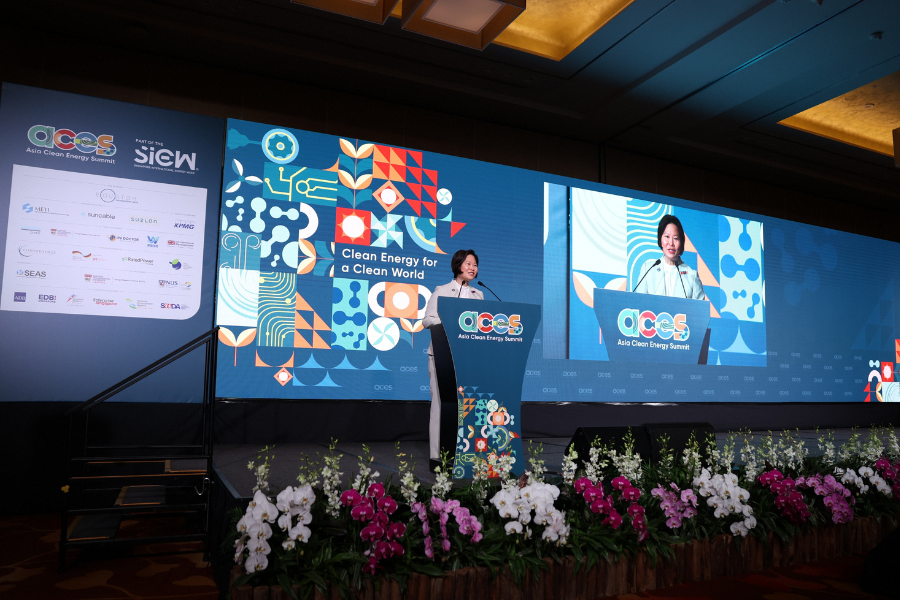
At the Asia Clean Energy Summit (ACES) 2026 Opening Ceremony, Er Edwin Khew, Chairman, Sustainable Energy Association of Singapore (SEAS), highlighted the need for stronger grids and regional cooperation. The opening address by H.E. Gan Siow Huang, Minister of State, Ministry of Foreign Affairs and Ministry of Energy, Trade and Industry, Singapore, then turned to Singapore's latest solar initiatives and progress on electricity imports.
Strengthening regional energy resilience
Mr Khew highlighted Southeast Asia's growing energy requirements. According to projections from the International Energy Agency (IEA), the region could account for 20 to 25 percent of global energy demand growth by 2035. He stressed that expanding renewable generation must be accompanied by investments in electricity grids, storage and market flexibility.
The ASEAN Power Grid, he noted, could strengthen regional energy resilience through greater cross-border electricity trade. It could also help unlock renewable resources and attract investment in clean energy infrastructure.
At the domestic level, Mr Khew also highlighted SEAS' collaboration with the Energy Market Authority (EMA) of Singapore to encourage residential solar adoption. The partnership aims to connect homeowners with suitable solar installers.
Maximising Singapore's solar potential
H.E. Ms Gan outlined Singapore's efforts to expand solar deployment despite land constraints. The country has raised its solar deployment ambition to 4 gigawatt-peak (GWp) by 2035.
EMA has launched a framework to aggregate demand for solar installations across public premises, including solar carports and building-integrated photovoltaics.
Meanwhile, JTC has awarded a pilot project for Singapore's first overhang solar installation at Woodlands East Industrial Estate. The project will install solar panels on an overhead structure spanning unused space between two industrial buildings. JTC has also launched two innovation challenges. These seek solutions for building facades and containerised solar paired with mobile battery energy storage systems.
Other initiatives include exploring solar roof tiles for heritage state buildings.
Advancing regional electricity trade
With domestic solar generation constrained by land availability, Singapore is pursuing low-carbon electricity imports to diversify and decarbonise its energy supply.
As part of these efforts, EMA recently granted Sembcorp Utilities conditional approval to import 1.3 GW of low-carbon electricity from or through Peninsular Malaysia. The project requires further development before imports can begin. Three projects now hold conditional approvals, potentially supplying up to 2.2 GW if all materialise.
H.E. Ms Gan also highlighted feasibility studies for a proposed second Singapore–Malaysia electricity interconnector to support future electricity imports. She stressed the need for clearer rules to facilitate cross-border electricity trade.
The updated Singapore Standard SS 673 also strengthens requirements for renewable electricity claims. Renewable Energy Certificates (RECs) used to substantiate such claims in Singapore must be associated with renewable electricity physically supplied to its grid.
RECs from overseas projects without such supply cannot support these claims. The changes aim to strengthen market confidence and could improve the commercial viability of electricity imports.
Exploring new low-carbon pathways
Beyond solar and low-carbon electricity imports, H.E. Ms Gan highlighted Singapore's continued exploration of nuclear and geothermal energy. These could provide reliable, low-carbon electricity if proven viable.
She also noted the appointment of Keppel, Sembcorp and Tuas Power as aggregators for the 300-megawatt (MW) Biomethane Sandbox. The initiative will assess the commercial viability of biomethane power generation.
Shaping Singapore's next energy chapter
Developing the next generation of energy professionals will also be important to Singapore's energy transition.
Drawing on her recent engagement with students from polytechnics, Institutes of Technical Education and universities, H.E. Ms Gan encouraged young Singaporeans to explore careers in the energy sector.
Her remarks came as EMA marks its 25th anniversary, drawing attention to the people who will help shape Singapore's energy future.
Follow @SIEW_sg on Telegram and X (formerly Twitter) for the latest insights and updates.