As Asia faces growing electricity demand and continued uncertainty in global energy supplies, closer government-industry cooperation will be critical to strengthening energy security, expanding gas infrastructure and advancing decarbonisation.
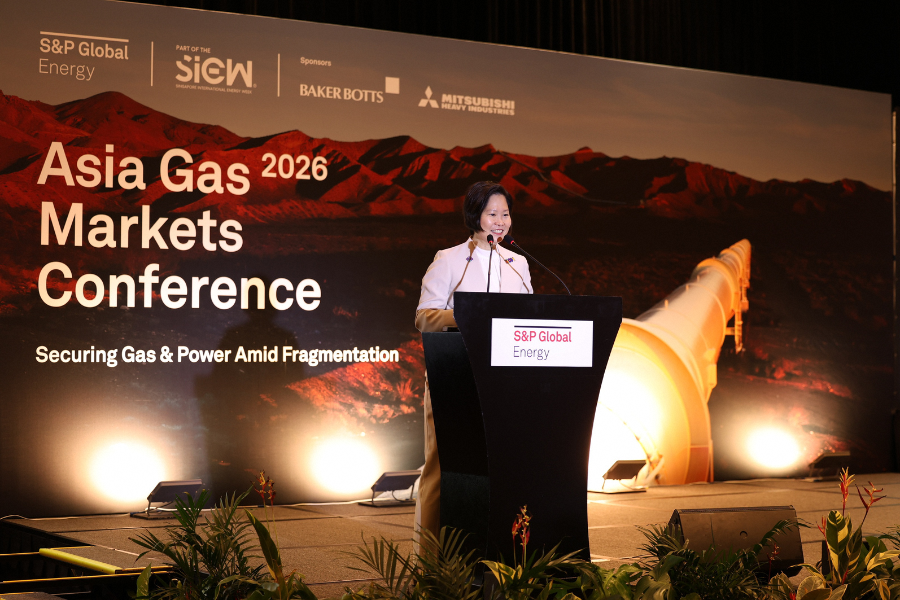
In her Opening Remarks at the Asia Gas Markets Conference on 27 October 2026, H.E. Gan Siow Huang, Minister of State, Ministry of Foreign Affairs and Ministry of Trade and Industry, Singapore, outlined three priorities for the gas industry: securing reliable liquefied natural gas (LNG) supplies, meeting rising energy demand and developing lower-carbon alternatives.
Strengthening LNG supply resilience
Recent supply disruptions have underscored that energy security depends not only on securing sufficient LNG volumes, but also on ensuring reliable deliveries when supplies become constrained.
H.E. Ms Gan highlighted the importance of flexible commercial arrangements between governments and industry to manage supply uncertainties. In Singapore, GasCo, established in 2025 to centralise gas procurement and diversify the country's supply portfolio, has launched its first Open Season to secure term LNG supplies.
Expanding infrastructure to meet Asia's growing demand
Asia is preparing for significant increases in gas-fired generation and LNG infrastructure. Between 2025 and 2030, ASEAN is expected to add around 24 gigawatts (GW) of gas-fired generation capacity and 34 million tonnes per annum (MTPA) of LNG regasification capacity.
In Singapore, five new gas-fired power plants will come online by 2031. The country's second LNG terminal will increase regasification capacity by 5 MTPA to 15 MTPA, while studies are underway to assess the need for and feasibility of a third terminal at Pulau Tekong.
H.E. Ms Gan emphasised that while governments can plan for future infrastructure needs, industry participation, technology and operational expertise will be essential to developing and operating these facilities.
Developing lower-carbon gas supply chains
Natural gas will remain an important transition fuel, but H.E. Ms Gan stressed the need to continue pursuing decarbonisation. She highlighted biomethane as a renewable alternative that could leverage ASEAN's existing gas infrastructure and supply chains, drawing on organic waste from the region's agricultural and palm oil industries.
Singapore recently appointed Keppel Energy, Sembcorp Utilities and Tuas Power as aggregators under its 300-megawatt (MW) Biomethane Sandbox. The initiative will test the commercial viability of importing and using biomethane for power generation and industrial decarbonisation.
It will also assess the supply chains, certification requirements and market arrangements needed for potential wider adoption, creating opportunities for the gas industry to develop regional biomethane supply chains.
Partnerships underpin Asia's energy future
H.E. Ms Gan concluded that securing reliable energy supplies, meeting growing demand and reducing emissions will require different approaches, but all depend on strong government-industry partnerships.
While governments can establish enabling policy frameworks, industry expertise and investment will be critical to strengthening energy resilience, developing commercially viable supply chains and keeping the energy transition practical and affordable.
Follow @SIEW_sg on Telegram and X (formerly Twitter) for the latest insights and updates.