Deploying advanced nuclear technologies requires more than choosing the right reactor. Countries must also prepare for the long-term commitments that nuclear energy entails.
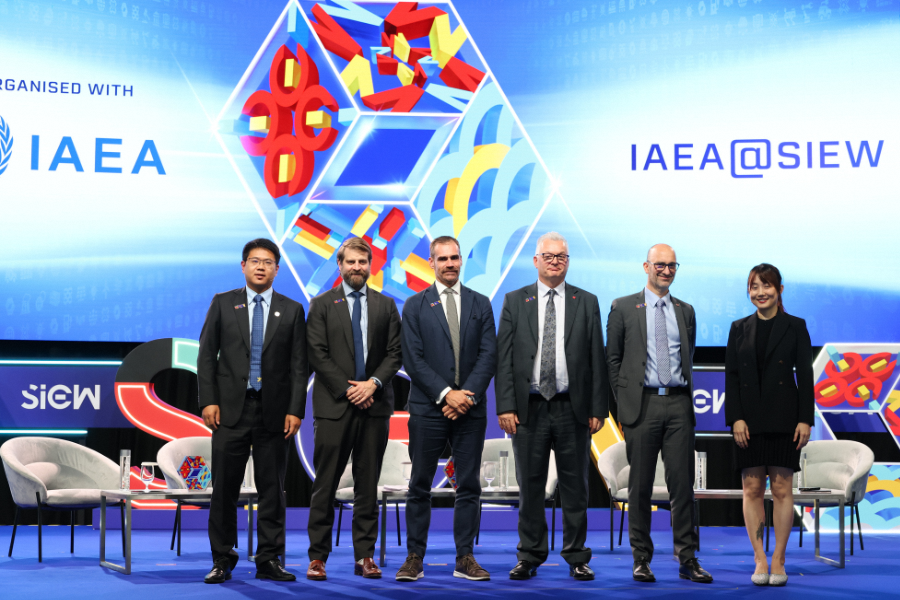
The IAEA@SIEW Forum Session 2 brought together industry leaders to examine the practical challenges of nuclear deployment. The discussion was moderated by Audrey Tan, Assistant News Editor (Environment), The Straits Times. The panel featured:
- Benjamin Reinke, Deputy Chief Commercial Officer, X-Energy
- Gary Rose, Executive Vice President, Nuclear, Canada, AtkinsRéalis, and President, CANDU International, Candu Energy Inc.
- Tom Greatrex, Chief Executive, Nuclear Industry Association, UK
- Lei Huang, Deputy General Manager, Hainan Nuclear Power Co., Ltd
- Antoine Guelfi, Head of BD, International Nuclear Development, EDF
Closing the session, Wei Huang emphasised the need for coordinated action on nuclear development. The International Atomic Energy Agency (IAEA) Director of Planning, Information and Knowledge Management underscored the importance of safety, security and non-proliferation.
Readiness goes beyond technology
Nuclear programmes require long-term planning and responsibilities spanning at least 100 years, according to Mr Guelfi. He highlighted the IAEA's Milestones Approach, which identifies 19 infrastructure issues countries must address. These include workforce development, industrial readiness and public engagement.
Preparing for such long-term commitments involves developing an entire nuclear ecosystem. Mr Rose stressed the need for regulators, educational partnerships, supply chains and operational expertise.
China's experience provides a practical example. Mr Lei highlighted collaboration with the IAEA that has supported workshops and simulator training for more than 100 personnel from different countries.
Matching technologies with energy needs
National energy priorities should guide reactor selection, rather than the other way around. Mr Reinke highlighted site suitability, cooling requirements, grid connections and regulatory considerations. He also pointed to opportunities to reuse grid connections at former thermal power plants.
Mr Rose explained that different reactor technologies serve different applications. Large reactors may be suitable for major urban electricity grids, while small modular reactors (SMRs) could serve smaller communities. Other designs may supply high-temperature steam for industrial processes. He also highlighted how nuclear power's steady electricity supply can complement variable renewable energy sources such as wind and solar.
Technology choices can also be informed by experience elsewhere. Mr Greatrex encouraged newcomer countries to learn from early SMR projects, particularly their construction requirements and challenges.
Strengthening safety and public trust
Public confidence requires early engagement as well as credible safety assurances. Mr Reinke emphasised clear communication with local communities about nuclear safety. Mr Rose cautioned against assuming newer reactors are inherently safer than established technologies. Such comparisons require licensing and operational evidence.
Mr Lei underscored the need for regulatory approvals and tested emergency response plans before operations commence. Mr Guelfi added that operational readiness depends on certified operators and simulator training.
Financing sustained nuclear deployment
Sustaining a nuclear programme requires planning beyond its first project. Mr Greatrex highlighted the risk that gaps between projects could erode workforce expertise and supply-chain capabilities.
Mr Rose highlighted the importance of government policies and project risk management in sustaining investment. Mr Greatrex described nuclear energy's role as critical national infrastructure, noting that government involvement need not entail state ownership.
Mr Lei identified sovereign guarantees and export credit arrangements as possible financing options. Mr Reinke added that financing models must reflect different electricity markets and revenue requirements.
Mr Guelfi also highlighted geopolitical risks. He stressed the importance of stable energy policies, reliable international partners and diversified uranium supplies.
IAEA urges coordinated action
Closing the session, Mr Huang called for coordinated action as interest in nuclear energy grows. He reaffirmed the IAEA's commitment to helping Member States prepare for nuclear energy through its Milestones Approach. Safety, security and non-proliferation must remain central to nuclear development, he stressed.
Follow @SIEW_sg on Telegram and X (formerly Twitter) for the latest insights and updates.