By Sylvia Ho
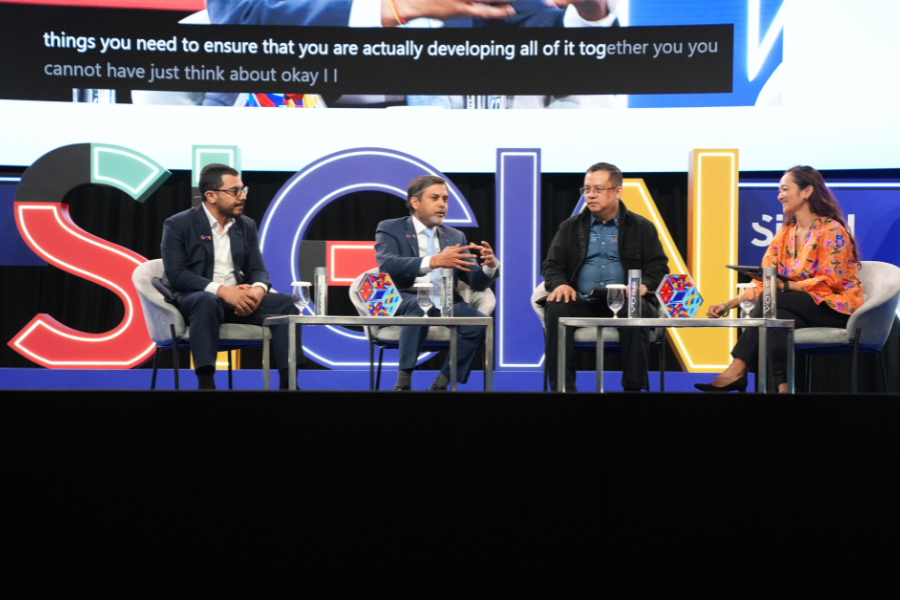
Renewable energy investment must extend beyond generation capacity to the infrastructure, expertise and policy frameworks that make projects viable and power supplies reliable. This was central to the discussions at SIEW Summit Day 2 fireside chat, moderated by Fauziah Marzuki, Head of Asia Pacific, BloombergNEF (BNEF).
Sushil Purohit, Group Chief Executive Officer, Gentari; Abdulla Zayed, Executive Director, Business & Project Development, Masdar; and H.E. Felix William B. Fuentebella, Undersecretary of Energy, Department of Energy, Republic of the Philippines, examined what is needed to turn renewable energy ambitions into deliverable projects.
Investing in the whole energy system
Mr Purohit highlighted the need to look beyond investment in renewable generation alone. Delivering reliable electricity at predictable prices also requires energy storage, transmission infrastructure, grid interconnections and long-term contracts.
He noted that developing these elements together can help meet continuous demand from energy-intensive users, including data centres, while supporting decarbonisation and diversifying energy supply.
Project capabilities matter as much as capital
Mr Zayed emphasised that financing is only one requirement for bringing complex renewable energy projects to fruition. Technical expertise, project development experience and collaboration among policymakers, developers and electricity buyers are also important.
He cited Masdar’s project in Abu Dhabi, developed with policymakers and off-takers, as an example of an integrated approach. The project combines five gigawatts (GW) of solar capacity with 19 gigawatt-hours (GWh) of battery storage and is designed to deliver one GW of continuous power.
Mr Zayed added that a demonstrated ability to deliver projects across different markets can help build confidence among investors and off-takers.
Aligning energy policy with market needs
H.E. Mr Fuentebella outlined three considerations guiding renewable energy development in the Philippines: access and affordability; reliability and resilience; and environmental sustainability.
He explained that these priorities inform long-term power supply agreements and the integration of technologies including solar, battery storage, biomass and offshore wind. The Philippines is also exploring nuclear energy and hydrogen as part of its broader energy options.
On regional cooperation, he highlighted the ASEAN Power Grid as a means of strengthening connectivity, with the potential to support energy security and mutual economic benefits.
Across the discussion, the speakers pointed to a shared implementation challenge: renewable generation must be supported by dependable infrastructure, capable project developers and policies that reflect electricity users’ needs. Coordinating these elements will be important to bringing projects forward while maintaining affordable, reliable energy supplies.
Follow @SIEW_sg on Telegram and X (formerly Twitter) for the latest insights and updates.