By Sylvia Ho
Mobilising capital is only part of the challenge in scaling renewable energy. Clear policies, predictable regulations, effective risk allocation and innovative financing structures are equally important in moving projects from development to financial close.
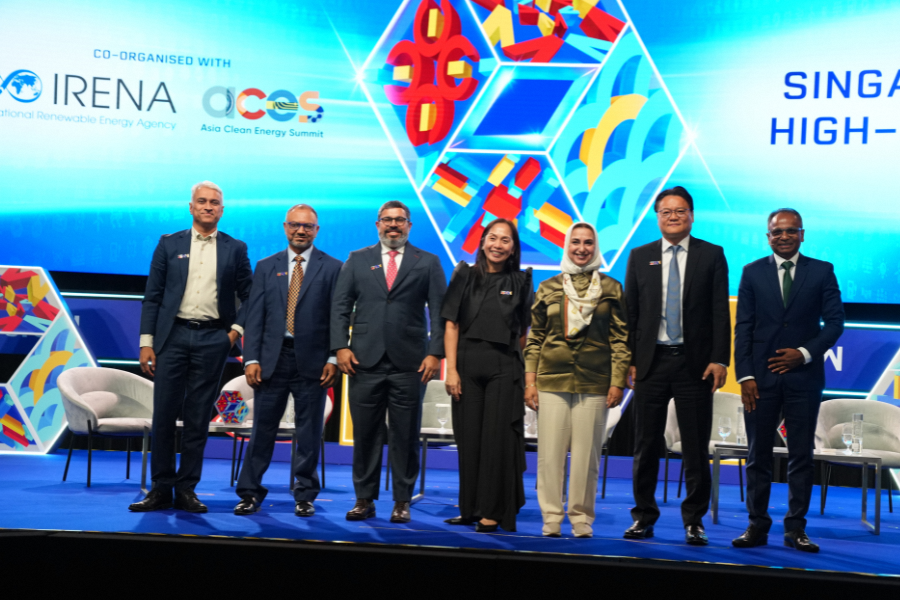
At the Singapore-IRENA High-Level Forum session 1 ‘From Projects to Capital — Unlocking Finance for Renewable Energy Projects’, policymakers, project developers and financial institutions discussed practical approaches to improving project bankability and strengthening investor confidence. The session was moderated by Lavan Thiru, Executive Director, Infrastructure Asia.
Policy certainty and adaptability to attract investment
The Honourable Sharon S. Garin, Secretary, Department of Energy, Republic of the Philippines, highlighted how the country's Green Energy Auction programme has supported project financing by offering fixed rates over 20 years. She shared that approximately 20 gigawatts (GW) of capacity have been awarded, with another 25 GW planned for auction within the next 12 months, for delivery between 2027 and 2035.
She added that policies must also evolve with market conditions and technological developments.
H.E. Dr Nawal Al-Hosany, Permanent Representative of the UAE to the International Renewable Energy Agency (IRENA), outlined three priorities for regulation: anticipating market developments rather than reacting to them, taking an integrated energy-system approach, and providing certainty through clear rules, credible institutions and consistent long-term policies.
She said that regulatory delays can increase financing costs, underscoring the need for regulation to keep pace with technological advances.
Flexible financing models to improve bankability
Yash Shah, Head of Energy Asia, SMBC, highlighted how financial institutions are adapting financing structures to manage risks. These approaches include financing at the holding-company level to support early-stage expenditure and project pipelines, rather than individual assets alone. For merchant projects, financing can also begin with lower leverage, which may increase as offtake contracts are secured.
Sharad Somani, Partner, Head of Infrastructure Advisory, Head of Infrastructure, Asia Pacific and Head of ESG Consulting, KPMG in Singapore, identified environmental conditions, supply chain disruptions and grid constraints as key risks affecting project bankability. He emphasised the importance of environmental and climate modelling to assess how haze, cloud cover and typhoons could affect solar generation.
James Lok, Manager, Project and Corporate Finance Clients Department, Global, Asian Infrastructure Investment Bank (AIIB), said that credible revenue models, project readiness and appropriate risk allocation are essential to securing financing.
He highlighted AIIB's role in strengthening project preparation and mobilising private capital through long-term financing, standardised structures, and repeatable procurement approaches and investment platforms.
Sharing risks in cross-border electricity projects
Mitesh Patel, Chief Operating Officer, SunCable, outlined the financing challenges facing large-scale cross-border electricity import projects, including long development timelines, differing offtake planning horizons and regulatory uncertainties.
He emphasised the need for financing structures that reflect the long lifespans of infrastructure assets, alongside closer collaboration between developers, financiers and regulators to allocate risks and share benefits across jurisdictions.
From project readiness to financial close
The discussion highlighted that renewable energy investment depends on more than capital availability. Projects must also demonstrate commercial viability, manage risks effectively and operate within predictable regulatory frameworks.
Summing up the session, moderator Lavan Thiru highlighted the importance of co-developing comprehensive financing solutions, diversifying the energy mix, strengthening regulations, integrating energy systems and allocating risks effectively. Together, these measures can help improve project bankability and support the delivery of renewable energy infrastructure.
Follow @SIEW_sg on Telegram and X (formerly Twitter) for the latest insights and updates.