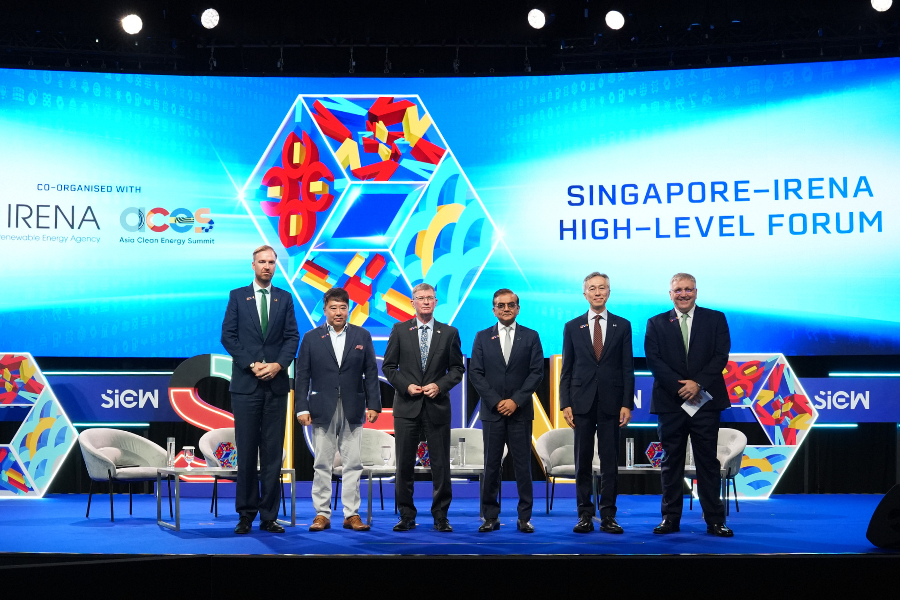
What will it take to turn regional power grid ambitions into investment-ready projects? At the Singapore-IRENA High-Level Forum, panellists discussed how regulation, financing and flexible technologies could advance cross-border energy connectivity.
The focus was Session 2, ‘Connecting the Systems: Financing the Grids and Infrastructure and Greening Industries That Power Tomorrow’.
The panel brought together Frank Phuan, Founder and Chief Executive Officer, Equator Renewables Asia; Randolph Brazier, Global Head of Clean Power Systems, HSBC; and Girish Tanti, Co-Founder, Suzlon Group.
Joining them were Hideaki Iwasaki, Director General, Sectors Department 1 (Energy and Transport Sectors), Asian Development Bank (ADB); and Erik Westergaard, Deputy and Acting Chair, Electricity Authority (New Zealand). Timothy Histed, Acting Head of East Asia Pacific, Multilateral Investment Guarantee Agency (MIGA), moderated the discussion.
From India's Green Corridors to the ASEAN Power Grid
According to Mr Tanti, India's renewable energy expansion illustrates how coordinated policies and long-term infrastructure planning can support deployment. He attributed the country's progress to government-backed demand aggregation, transparent bidding processes and long-term investment visibility.
India's green energy corridors, which strengthen transmission infrastructure for renewable power, have helped accommodate growing renewable capacity. Their development is supported by 20-year grid planning. Local manufacturing, skills development and supply chains were also among the factors Mr Tanti identified as important for sustaining deployment.
For regional power connectivity, regulatory certainty is another consideration. Mr Westergaard highlighted the role of robust regulation, transparent electricity pricing and competitive markets in building investor confidence. He also emphasised the need for clarity over how transmission costs are shared.
Looking ahead, he envisaged the ASEAN Power Grid developing in phases. He suggested that this could begin with stronger connections between Singapore and Malaysia before expanding across the region.
Blended finance could ease investment risks
Mr Brazier identified revenue uncertainty and regulatory instability as major barriers to financing grid infrastructure. Projects that depend on one another can also pose investment risks.
Potential solutions include project financing for standalone batteries and grids, green bonds and sustainability-linked loans. Blended finance could also help reduce these risks. It combines public and development bank support with private capital.
Mr Iwasaki highlighted the 600-megawatt Monsoon Wind project in Lao People's Democratic Republic. The project exports electricity to Vietnam. It illustrates how different funding sources can support cross-border electricity trade.
ADB helped mobilise financing from development, commercial and concessional sources. Mr Iwasaki also emphasised the importance of longstanding government relationships and institutional trust in the project's success. Efforts to address regulatory bottlenecks were another factor he identified.
Flexible technologies for cross-border power
Mr Phuan highlighted the need for greater regulatory clarity on cross-border electricity exports. He pointed specifically to export licence tenure for electricity supplied from Indonesia to Singapore.
His company is developing flexible energy solutions in the meantime. These include containerised solar systems and mobile battery energy storage systems. One proposal involves transporting stored electricity between islands using batteries carried by vessels. This could offer an alternative where permanent power connections are difficult to establish.
Regional energy connectivity will require coordinated infrastructure planning, suitable financing models and flexibility in how electricity is delivered. Clearer regulations could help turn these ambitions into viable cross-border projects.
Follow @SIEW_sg on Telegram and X (formerly Twitter) for the latest insights and updates.