Recent supply disruptions have tested the resilience of the global liquefied natural gas (LNG) market. The redirection of cargoes to Asia has demonstrated the market's responsiveness, even as supply risks persist.
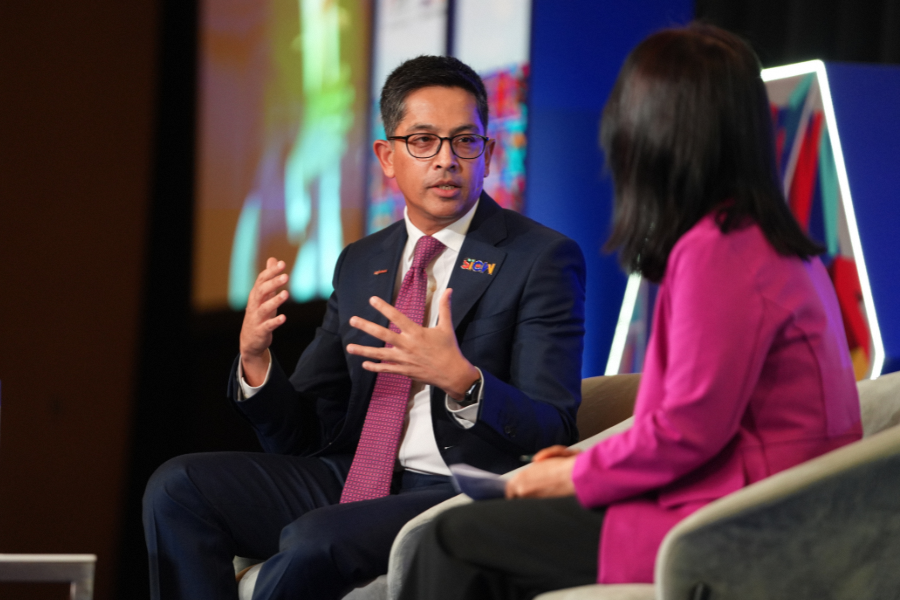
These developments framed the SIEW Energy Insights session, Global LNG and Gas Outlook: Strengthening Energy Security in Asia. The discussion featured Sid Bambawale, Global Head of Energy Trading and Head of Asia Gas & Power, ExxonMobil. Liu Xiaowei, Asia Director and Senior Advisor, World Energy Council, moderated.
Global LNG market adapts to supply disruptions
Middle East-related supply disruptions have kept LNG prices elevated as the northern hemisphere approaches winter.
Mr Bambawale pointed to cargoes redirected to Asia from the US, Canada and Africa as evidence of a larger, more responsive global LNG market. However, he cautioned that this responsiveness did not eliminate the impact of supply disruptions.
Asian buyers balance diversification and long-term supply
Mr Bambawale noted that Asian buyers had diversified their LNG procurement to manage supply disruptions. This included sourcing from different regions, using alternative trade routes and adopting different pricing benchmarks.
Buyers can also manage immediate supply needs through storage, inventory swaps and coordination. Mr Bambawale cited partial cargo purchases in Southeast Asia as an example of how buyers had responded to higher prices.
Over the longer term, supply commitments help ensure reliable volumes while giving suppliers greater certainty to invest in new projects. Yet Mr Bambawale stressed that flexibility has both value and cost.
Managing this trade-off requires a mix of long-, medium- and short-term supply commitments. Buyers also need flexibility in their contracts and infrastructure. This helps them respond to changing demand without relying on a single supply source or contract type.
Asia expected to account for most global LNG growth
That flexibility will become increasingly important as Asia's LNG needs grow. Mr Bambawale projected that global LNG supply and demand could roughly double over the next 25 years. Asia could account for almost 70 percent of that growth. He linked this growth to urbanisation, industrialisation, electrification and demographic trends, particularly in Southeast Asia.
On the supply side, he pointed to Golden Pass LNG in the US, as well as potential portfolio sources in Mozambique and Papua New Guinea. New projects, however, would take time to ramp up.
Gas-fired power requires coordinated infrastructure
Mr Bambawale also highlighted the role of gas-fired generation in meeting growing electricity demand and complementing intermittent renewable energy. Reliable power generation depends on supporting infrastructure.
LNG terminals, storage facilities, electricity grids and power-generation equipment must be planned together. Such coordination can help ensure that gas supplies support reliable electricity generation.
Beyond infrastructure planning, cooperation is needed among buyers, sellers and infrastructure providers. Governments and national companies can also help coordinate LNG supply with power generation needs, he said.
A deeper global LNG market gives Asian buyers more options to manage disruptions, Mr Bambawale noted. Putting those options to use will be increasingly important as the region's energy needs grow.
Stay tuned as the conversation evolves throughout the day. Follow @SIEW_sg on Telegram and X (formerly Twitter) for key insights and the latest updates.