By Sylvia Ho
Oil supply disruptions and accelerating electrification are reshaping China's oil and petrochemical market. While demand for conventional transport fuels is declining, petrochemical feedstocks are expected to account for a growing share of oil consumption.
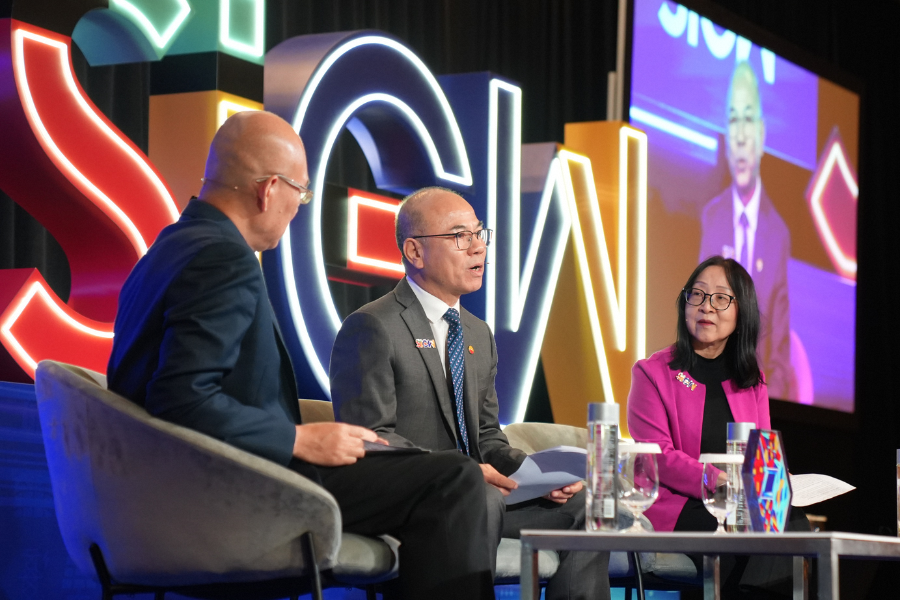
At the SIEW Energy Insights session ‘China's Oil & Petrochemical Market Outlook’, Wu Qiunan, Director of Global Market Analysis & Strategy Research Center, PetroChina International, presented findings on global and Chinese oil markets.
He was joined by Liu Qiang, Director of Energy Security Studies and Secretary General of the Global Forum on Energy Security, Institute of Quantitative & Technological Economics, Chinese Academy of Social Sciences (CASS), for a discussion moderated by Dr Liu Xiaowei, Asia Director and Senior Advisor, World Energy Council.
Oil supply disruptions test China's energy resilience
Mr Wu highlighted how supply disruptions in the Strait of Hormuz have tightened global oil supplies, driven price volatility and increased pressure on oil-consuming economies. While traditional responses to oil crises have focused on increasing production and releasing strategic reserves, he noted that major consumers such as China can also help cushion supply shocks through demand adjustments.
He attributed China's resilience to diversified oil import sources, land-based pipelines and inventories accumulated over 15 years.
Mr Liu added that China's diversified energy mix, growing electric vehicle adoption and domestic fuel price adjustment mechanisms have helped mitigate the impact of rising global oil prices.
Electrification reshapes demand for oil
Mr Wu noted that China's demand for conventional transport fuels, including petrol, diesel and jet fuel, is declining amid electrification, high oil prices and industrial upgrading. Policy support for electric vehicles, liquefied natural gas (LNG) vehicles and alternative transport modes, alongside advances in new energy technologies, is reinforcing this shift.
In contrast, demand for oil as a petrochemical feedstock is expected to grow. Mr Wu projected that the share of crude oil used for petrochemical production could rise by approximately 26-36 percent by 2030, reflecting a structural shift from fuels towards materials.
However, Mr Liu highlighted the challenges of restructuring existing refining capacity, including competition from coal-based chemical production. Mr Wu added that while the direction of the transition is clear, its pace will depend partly on policy incentives and market responses.
Integrating low-carbon solutions into petrochemical production
The discussion also explored opportunities to integrate electricity generation and petrochemical production to reduce emissions.
Mr Wu cited an ethylene project in Xinjiang that combines green electricity, carbon capture, blue hydrogen and blue ammonia.
Mr Liu highlighted opportunities to use renewable electricity to produce green hydrogen for refining and petrochemical processes. He also suggested that greater integration with power generation, including the recovery of excess industrial heat, could create additional opportunities for the sector.
China's energy transition gathers pace
Mr Wu noted that the Strait of Hormuz disruptions have reinforced China's resolve to accelerate its energy transition. Referring to China's 15th Five-Year Plan for the construction of a new energy system, he said coal and oil consumption are expected to peak before 2030.
However, demand for oil used in petrochemical production is projected to continue growing, contributing to a more diversified oil product mix.
Looking ahead, the discussion highlighted how China's oil and petrochemical sector is moving beyond conventional fuel production towards materials, technological innovation and closer integration with the electricity system. The pace of this transformation will depend on policy support, industrial restructuring and the sector's ability to balance energy security with decarbonisation.
Stay tuned as the conversation evolves throughout the day. Follow @SIEW_sg on Telegram and X (formerly Twitter) for key insights and the latest updates.