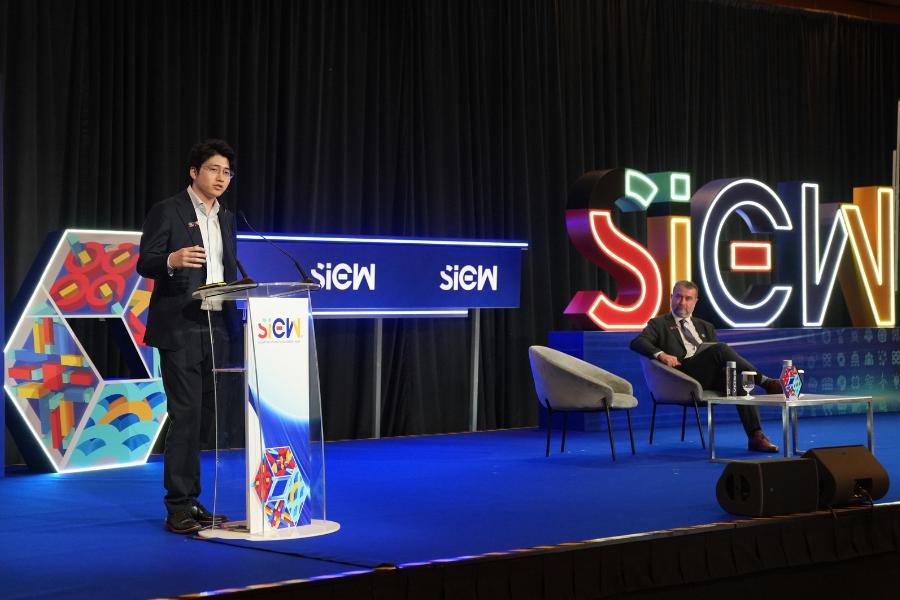
Getting more usable electricity from solar power was a central theme at SIEW TechTable Session 3. The challenge is turning greater solar potential into reliable, usable power.
Focused on Solar and Battery Storage Solutions, the session brought together three industry speakers. They were Henry Liang, Technical Head of Southeast Asia, CATL, and Yushi Nakamura, Head of Business Development, Perovskite PV Business Promotion Office, Panasonic Holdings Corporation. The third speaker was Dan Tennakoon, Founder & CEO, RE24.
Moderating the discussion was Gurbuz Gonul, Director, Country Engagement & Partnerships, International Renewable Energy Agency (IRENA).
Urban buildings could offer more space for solar
In densely populated cities, limited rooftop space is a practical constraint on solar deployment. Perovskite building-integrated photovoltaics (BIPV) use solar-generating materials incorporated into building surfaces. Mr Nakamura presented this approach, known as building-integrated photovoltaics (BIPV), as a way to unlock underutilised urban surfaces.
Unlike conventional rooftop installations, perovskite BIPV could transform building facades, balcony railings, skylights and canopies into electricity-generating assets. Mr Nakamura estimated that vertical surfaces in cities could offer two to three times as much space for solar installations as rooftops, depending on local conditions. The estimate concerns installation space, not electricity output.
The benefits could extend beyond electricity generation. Mr Nakamura highlighted the technology's potential to enhance building value and offer greater architectural design flexibility. Paired with battery storage, it could also improve energy resilience.
Scaling perovskite solar requires more than technology
With initial perovskite products already on sale in Japan, wider adoption will require more than technological improvements. Mr Nakamura identified market awareness and efficiency at larger product sizes as key challenges. Developing an integrated value chain would also be important for scaling up.
As BIPV could replace conventional architectural glass, its use would require closer collaboration among developers, architects and electrical installers.
Battery economics depend on lifetime performance
Making greater use of solar electricity beyond daylight hours also depends on reliable and economically viable storage. Mr Liang emphasised that battery energy storage systems (BESS) should be evaluated over their operational lifespan, rather than on upfront costs alone.
Safety, reliability, battery degradation and round-trip efficiency all influence how much electricity a battery system can deliver over time. These considerations are particularly important in Southeast Asia, where high temperatures, humidity and severe weather place additional demands on equipment.
Against these performance considerations, sodium-ion batteries could complement existing lithium-ion technologies, according to Mr Liang. He cited potential advantages in cycle life, high-temperature performance and material-cost stability. However, their less mature supply chain remains a barrier to commercial competitiveness.
The value of storage also depends on how it is deployed. Mr Liang explained that solar-plus-storage economics vary across markets, partly because of electricity prices. Batteries can shift surplus daytime solar electricity to evening or night-time demand. Mr Liang also stressed the importance of validating complete storage systems rather than individual components alone.
Flexible data centres could help close the 24/7 clean power gap
Battery lifetime performance also matters when storage is used to match renewable electricity with demand. For energy-intensive industries such as data centres, shifting electricity use could improve hourly clean power matching while reducing strain on batteries.
Mr Tennakoon explained that matching annual electricity consumption with renewable generation does not guarantee clean electricity around the clock.
He estimated that combining renewable sources such as solar and wind could achieve approximately 70-80 percent hourly matching. Based on RE24's experience, he considered this commercially viable. Bridging the remaining gap, however, would require additional technologies at a cost premium.
Mr Tennakoon highlighted the potential of behind-the-meter battery storage and flexible computing demand to improve hourly clean electricity matching. Shifting computing loads could help data centres make better use of clean electricity. Optimising battery charging and discharging could limit degradation. He also discussed research into digital models to simulate computing demand and improve battery performance over time.
Such flexibility could also help data centres manage constraints on grid capacity. Mr Tennakoon drew on examples from Ireland and the UK to discuss possible approaches for Singapore. These included dispatchable power and flexibility during peak demand, subject to local market conditions.
Beyond managing demand, technologies that store energy for later use could help extend clean electricity supply. Mr Gonul pointed to concentrated solar power with molten-salt storage as one potential option.
Realising the potential of these approaches will depend on overcoming practical deployment barriers and ensuring storage remains reliable and commercially viable. Better coordination between clean electricity supply, storage and demand could help make round-the-clock power more achievable.
Stay tuned as the conversation evolves throughout the day. Follow @SIEW_sg on Telegram and X (formerly Twitter) for key insights and the latest updates.