By Jin Wang
As electricity demand grows and power networks become more complex, artificial intelligence (AI) offers opportunities to improve grid operations and accelerate digitalisation. However, its deployment in critical infrastructure must be supported by reliable data, proven engineering and human oversight.
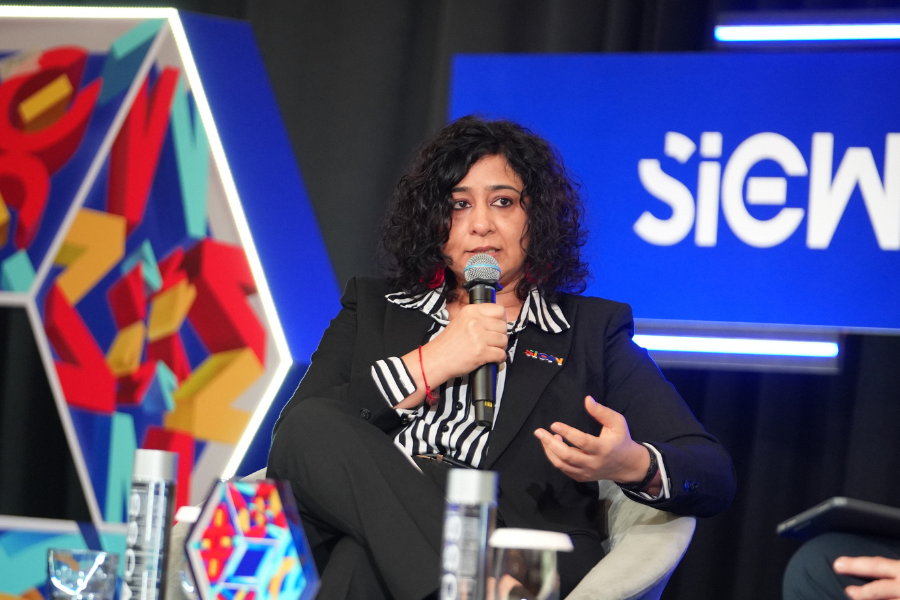
At SIEW TechTable, Kusum Verma, Director of Infrastructure Segments for APAC, Schneider Electric, shared practical AI applications in grid management. The session, ‘The Future of Grid Management, Powered by AI’, was moderated by Tim Rockell, Managing Director, Energy Strat Asia.
Tapping on AI to improve grid operations
Mr Verma highlighted Schneider Electric's AI Grid Assistant, which helps operators navigate the more than 40 functions of Advanced Distribution Management Systems (ADMS). Drawing on technical documentation, the tool supports day-to-day operations while helping operators develop their technical capabilities.
Another solution, Grid Vision, can convert existing network diagrams, including PDF files, into digital models, reducing the manual work required during ADMS implementation.
Mr Verma also cited projects where AI applications had saved approximately 200 to 300 hours of implementation work. With ADMS implementation typically taking three to six months or longer, he estimated potential time savings of 20–30 percent or more, depending on the project. He stressed the importance of applying AI to specific operational challenges where it can deliver meaningful efficiency gains.
Human oversight remains essential for critical infrastructure
Responding to Mr Rockell's questions on operational safety and accountability, Mr Verma emphasised that AI should assist rather than replace human decision-making.
AI tools provide guidance and recommendations, while operators remain responsible for validating information and determining appropriate actions. Combining AI capabilities with engineering expertise is particularly important for mission-critical grid operations.
Mr Verma outlined three complementary layers of grid intelligence: deterministic, rule-based systems; machine learning that draws on historical data; and generative AI applications such as Grid AI Assistant and Grid Vision. These capabilities must work together, supported by digitalisation, automation and a strong data foundation.
Rising electricity demand is increasing the need for intelligent grids
Growing demand from data centres is placing pressure on electricity systems, while AI can help operators manage increasingly complex networks. Mr Verma pointed to energy investment and development plans in Indonesia, Vietnam and Thailand, alongside cross-border projects between Singapore and Indonesia.
However, he noted that execution continues to lag behind planning, highlighting the need for stronger regulatory support and coordinated action.
The session underscored the potential for AI to improve grid efficiency without replacing the expertise of experienced operators. As electricity demand grows and regional energy systems become more interconnected, effective deployment will depend on reliable data, engineering expertise and human oversight.
Stay tuned as the conversation evolves throughout the day. Follow @SIEW_sg on Telegram and X (formerly Twitter) for key insights and the latest updates.