Electricity grids take years to plan and build, but businesses increasingly need larger power connections at shorter notice. This puts pressure on utilities to plan ahead while keeping electricity supply reliable.
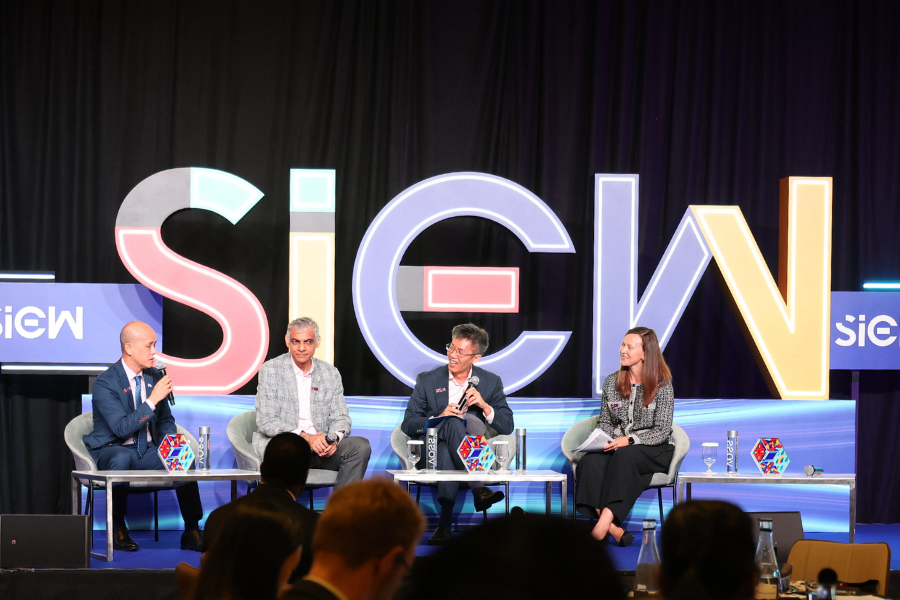
At Spotlight U.S. Forum Session 1, Keeping the Lights On and Powering the Digital Economy: Can ASEAN’s Energy Transition Keep Up?, panellists explored how infrastructure investment and artificial intelligence (AI) could help address these challenges. They also examined the role of cross-border electricity cooperation.
The discussion featured Arun Biswas, Strategic Engagements Leader Asia Pacific, IBM; Desmond Li, Director, Stakeholders & Strategy, SP Group; and Kenneth Kong, Senior Managing Director - APAC, Infrastructure Advisory, Black & Veatch. Jenny Schuch-Page, Partner, The Asia Group, moderated.
Preparing grids for growing digital demand
Mr Li explained that demand from AI data centres and semiconductor manufacturers is making grid planning less predictable. Utilities must decide how much capacity to build, where and when, while maintaining network reliability.
He noted that Singapore imports grid equipment such as transformers and switchgear. Managing supply-chain risks is therefore important. SP Group is addressing these risks by diversifying suppliers and sourcing locations.
Investment certainty is another consideration for infrastructure development. Mr Kong considered capital availability relatively favourable for energy infrastructure projects across Southeast Asia. However, he emphasised the importance of regulatory certainty, trusted partnerships and reliable contracts in supporting investment decisions.
Using AI to manage grid capacity
Alongside infrastructure investment, AI could help utilities make better use of existing grid capacity. Mr Li discussed how the technology could support field personnel and optimise network assets. AI could eventually help operators assess available capacity while managing network risks.
Other applications include predictive maintenance, energy forecasting and cybersecurity, Mr Biswas noted. He also discussed emerging grid foundation models and AI-enabled coordination across energy networks.
Putting these applications into practice requires more than technology. Reliable, usable data and basic digital capabilities are essential. Workforce training, organisational change and strong governance frameworks are also needed to support wider adoption, Mr Biswas added.
Making cross-border electricity trade work
Cross-border electricity trade could broaden energy supply options as demand grows. Mr Kong emphasised the value of combining domestic energy resources with electricity imports to strengthen energy security.
For Singapore, which has limited domestic energy resources, Mr Li pointed to the importance of regional electricity interconnections. These would require information-sharing arrangements to coordinate operations across borders.
Intelligent systems could also help countries make better use of interconnected electricity networks, Mr Biswas noted.
The discussion underscored the challenge of preparing electricity networks for demand that is growing and becoming harder to predict. For ASEAN, timely infrastructure investment will remain important, supported by AI-enabled grid management and closer regional electricity cooperation.
Stay tuned as the conversation evolves throughout the day. Follow @SIEW_sg on Telegram and X (formerly Twitter) for key insights and the latest updates.