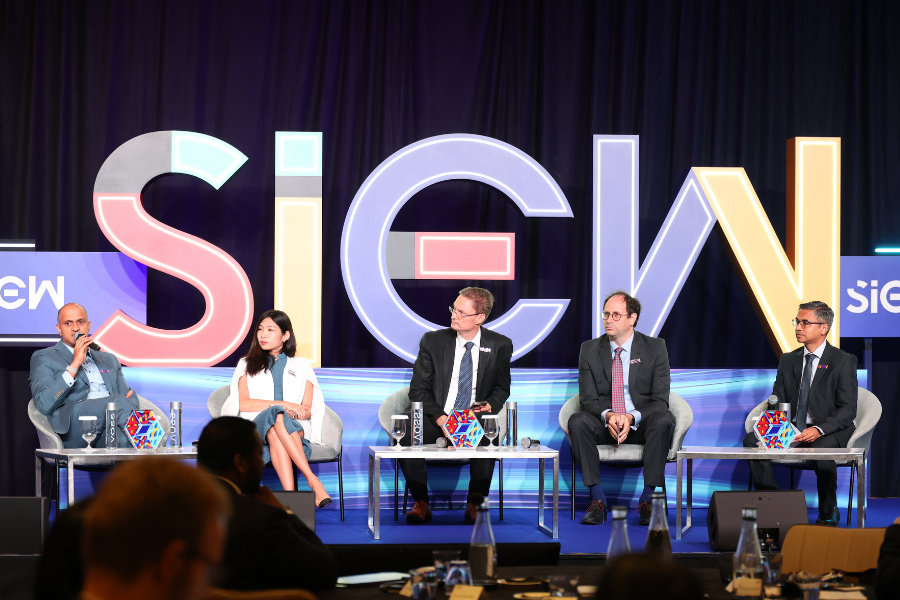
The rapid growth of artificial intelligence and data centres is creating new opportunities for energy investment across Southeast Asia. Realising this potential will require innovative financing and smarter grids. Stronger regional cooperation will also be key.
Panellists tackled these challenges at Spotlight U.S. Forum Session 2: Financing the Growth in the Digital Economy. They discussed how to turn the region's rising digital demand into viable energy investments.
The panel featured Rajiv Vishwanathan, Executive Director, Project Finance, DBS Bank; Genevieve Ding, Executive Director, Head of APAC Sustainability, JPMorganChase; and Martin Hauske, Sales Director (Asia Pacific), Grid Software, GE Vernova.
They were joined by Matthew Wittenstein, Senior Mining Specialist, Metals and Minerals Division, World Bank. The discussion was moderated by Abhishek Dangra, Managing Director, Analytical Manager, Corporate and Infrastructure Ratings, SSEA.
Dr James Andrade, Senior ASEAN Advisor, U.S.-ASEAN Business Council, delivered the Forum's closing remarks.
Bridging the digital energy gap
Mr Vishwanathan highlighted how electricity generation and grid development are struggling to keep up with the rapid expansion of AI infrastructure.
He proposed shorter-term solutions to ease electricity supply constraints while larger grid infrastructure is developed. These included microgrids combining solar energy and storage to support data centres, as well as greater flexibility in electricity demand.
Mr Hauske emphasised the potential of digitalisation and proven energy management technologies could optimise existing grid capacity. In addition, he suggested that data centres could support grid management by adjusting their electricity demand. This flexibility could accommodate digital growth without disproportionately increasing system costs.
Making energy projects bankable
Turning energy infrastructure plans into viable investments also requires the right financial conditions. Ms Ding outlined four requirements for bankable infrastructure projects. These are credible revenue models, reliable counterparties, predictable execution timelines and appropriate risk allocation.
She also explained how blended finance could help manage risks that commercial banks may be unable to absorb on their own. This approach combines public or development finance with private investment. Such risks include regulatory, geopolitical and currency uncertainties.
Mr Wittenstein, however, cautioned that financing was not necessarily the main challenge for infrastructure investment across ASEAN. He stressed the importance of sound governance and regulatory frameworks, alongside infrastructure development and workforce capabilities.
He also highlighted the role of materials and supply chains in energy development. As an example, he pointed to the World Bank's infrastructure corridor approach. This connects resource development with demand while supporting local economic benefits.
Advancing the ASEAN Power Grid
Regional electricity connectivity presents its own investment challenges. Mr Vishwanathan highlighted differences in national electricity market structures. He also pointed to difficulties in sharing electricity data and tracking renewable energy attributes.
Mr Hauske proposed starting with bankable projects involving two or three countries. These could build confidence before wider regional interconnections are developed.
Mr Wittenstein stressed the importance of aligning regional planning with national priorities. Participating countries also needed to see tangible benefits.
For energy-exporting countries, Ms Ding emphasised the importance of clear economic returns, employment opportunities and community benefits. These could help sustain political support and investor confidence.
Planning ahead for reliable power
In his closing remarks, Dr Andrade emphasised the need for coordinated energy planning. He called for earlier assessment of electricity demand and encouraged technology companies to help finance energy solutions. He urged progress on regional connectivity through bankable projects.
He stressed the need for collaboration among governments, energy companies, technology providers and financial institutions. Such cooperation would help ensure that digital growth is supported by reliable, affordable and sustainable electricity.
Stay tuned as the conversation evolves throughout the day. Follow @SIEW_sg on Telegram and X (formerly Twitter) for key insights and the latest updates.