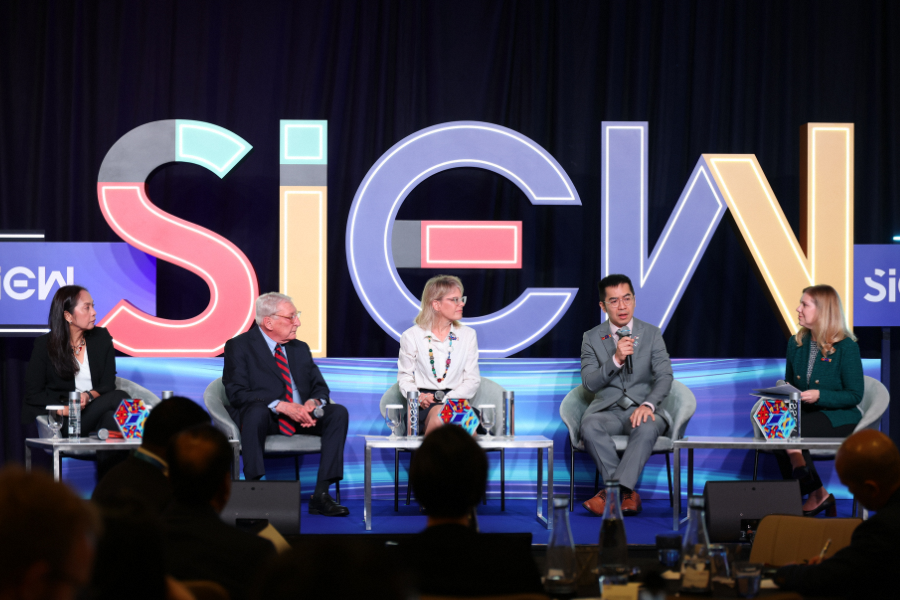
Could advanced nuclear energy help power Southeast Asia's growing digital economy? What capabilities and safeguards would countries need to explore this option? These were among the issues discussed at the Spotlight U.S. Forum Fireside Chat, Powering Data Centers & Strengthening Grids – The Next Decade.
The panel brought together four energy leaders:
- The Honourable Sharon S. Garin, Secretary, Department of Energy, Republic of the Philippines
- Ted Garrish, Assistant Secretary, Department of Energy, US
- Dr Kirsten Cutler, Senior Strategist for Nuclear Innovation, Bureau of International Security and Non-proliferation, U.S. Department of State
- Puah Kok Keong, Chief Executive, Energy Market Authority
Moderating the discussion was Dr Jennifer T. Gordon, Director of the Nuclear Energy Policy Initiative and Daniel B. Poneman Chair for Nuclear Energy Policy, Global Energy Center, Atlantic Council.
Discover the highlights from Spotlight U.S. Forum
Planning for rising electricity demand
Singapore's peak electricity demand is expected to rise from 8.6 gigawatts (GW) to between 9.9 and 13 GW within five years, according to the forecast by Singapore's Energy Market Authority (EMA). Mr Puah called for coordinated planning of gas supply, power generation and grid infrastructure to meet rising demand.
Five new natural gas-fired power plants are expected to come online between 2026 and 2031, with further capacity being evaluated for 2032. EMA is also evaluating further generation capacity for 2032 under its centralised planning framework.
In the Philippines, Secretary Garin outlined a different approach to accommodating new data centres. Her policy direction is for these facilities to secure their own power supply without adding strain to the national grid.
Exploring nuclear options for future demand
Mr Garrish highlighted nuclear energy's potential to provide reliable electricity for data centres. Small modular reactors (SMRs) and microreactors are among the options Secretary Garin identified for providing that dedicated power. She pointed to the Philippines' engagement with US advanced nuclear technology developers to explore opportunities along the Luzon Economic Corridor.
Preparing to assess nuclear deployment
Technical expertise and regulatory readiness are central to assessing advanced nuclear energy. Mr Garrish outlined US support for ASEAN countries through national laboratory exchanges, regulatory capacity-building and governance assistance. For Singapore, this includes technical research into reactor and fuel safety at Idaho National Laboratory.
Financing is another consideration. Mr Garrish highlighted the Convention on Supplementary Compensation for Nuclear Damage (CSC). The convention provides a framework for compensation following a nuclear accident. He linked participation in it to certain financing arrangements for overseas nuclear projects.
Some forms of civilian nuclear cooperation, including transfers of nuclear materials and technology, require an appropriate legal framework.
Dr Cutler pointed to bilateral 123 Agreements with the Philippines and Singapore. These agreements provide a framework for cooperation involving nuclear fuel, equipment, components and reactors, subject to applicable requirements.She also cited the U.S. Foundational Infrastructure for Responsible Use of Small Modular Reactor Technology (FIRST) programme.
These initiatives can help countries make informed decisions on whether to pursue advanced nuclear deployment.
Stay tuned as the conversation evolves throughout the day. Follow @SIEW_sg on Telegram and X (formerly Twitter) for key insights and the latest updates.