Promising low-carbon technologies could play a greater role in Asia's energy future. But realising their potential requires more than technological innovation.
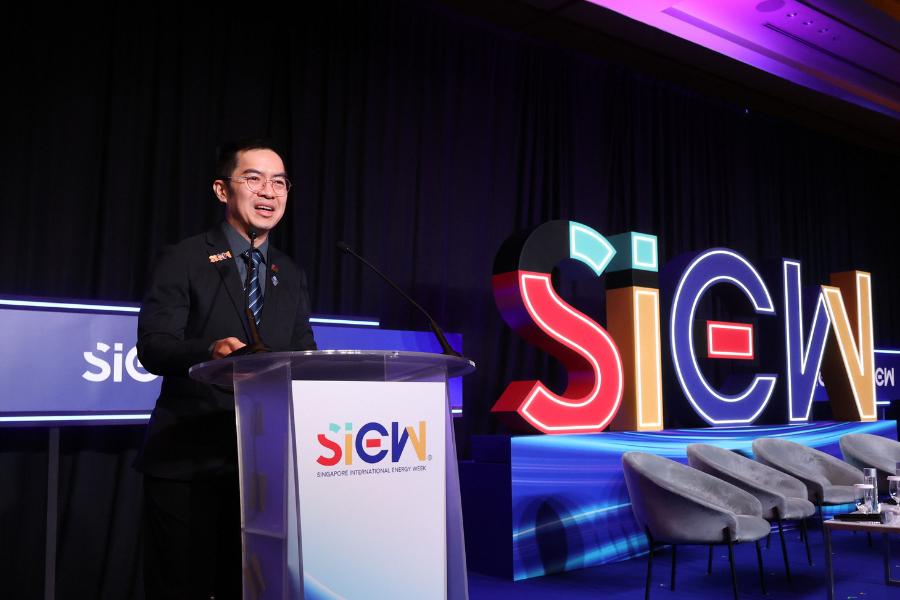
SIEW Thinktank Roundtable C, on Advancing Emerging Energy Technologies for Asia's Low-Carbon Future, opened with remarks on how emerging technologies could be brought into wider use. The opening speakers were Puah Kok Keong, Chief Executive of the Energy Market Authority (EMA), and Professor Madhavi Srinivasan, Executive Director, Energy Research Institute @ NTU (ERI@N).
Geothermal and biomethane expand Singapore's energy options
Mr Puah emphasised the need for diverse low-carbon solutions as Asia seeks to meet growing energy demand while maintaining energy security and affordability. He highlighted geothermal energy and biomethane as two promising options.
Singapore's nationwide geophysical survey had identified sizeable geothermal resources deep underground, Mr Puah shared. Further assessments will determine whether these resources can be harnessed for power generation, heating and cooling.
Singapore is also exploring biomethane, a renewable gas produced from organic waste. Biomethane could offer a lower-carbon alternative to natural gas.
Mr Puah highlighted the appointment of Keppel Energy, Sembcorp Utilities and Tuas Power as aggregators under Singapore's biomethane regulatory sandbox. The sandbox will test imports and industrial supply arrangements to assess what is needed for a potential market in Singapore.
Funding helps move innovation towards deployment
Beyond technological potential, Mr Puah underscored the importance of investment and collaboration in bringing emerging solutions to market. He highlighted a $75 million power decarbonisation funding initiative to support research, test-bedding and piloting of low-carbon technologies. EMA and the Advanced Energy and Decarbonisation Office launched the initiative.
To connect research more closely with industry needs, Singapore has also launched the $25 million Decarbonisation Research for Industry, Ventures, and Enterprise (DRIVE) scheme. It brings researchers and companies together to develop solutions for industry.
Mr Puah also pointed to efforts to make existing clean-energy solutions more accessible. These include a new collaboration between EMA and the Sustainable Energy Association of Singapore. The collaboration aims to enhance a digital platform that connects homeowners with solar providers, helping simplify rooftop solar adoption.
Scaling technologies for wider use
While Mr Puah outlined initiatives to support deployment, Prof Srinivasan turned to the lessons from lithium-ion batteries. Their evolution illustrated how sustained research, investment and manufacturing capabilities supported commercial viability. Once costly and complex, the technology eventually achieved widespread adoption.
She explained how different groups contributed to this progress. Researchers improved performance, investors supported innovation, and companies developed capabilities for large-scale deployment.
Drawing on this example, Prof Srinivasan suggested that hydrogen, carbon capture and utilisation, geothermal energy and biomethane could follow a similar path towards wider adoption. Their progress would depend on continued support for development and scaling.
Singapore's efforts to assess geothermal resources and test biomethane supply pathways show how promising technologies are being explored for practical use.
Whether these and other emerging technologies achieve wider adoption will depend on their commercial viability and ability to meet Asia's energy needs.
Stay tuned as the conversation evolves throughout the day. Follow @SIEW_sg on Telegram and X (formerly Twitter) for key insights and the latest updates.