Sweden brings energy expertise, while Singapore offers strong regional connections. Together, these strengths could open new opportunities for collaboration as Southeast Asia works towards a more secure and sustainable energy future.
The potential for such collaboration was highlighted during the opening of the Spotlight Sweden Forum. The welcome remarks were delivered by Puah Kok Keong, Chief Executive of the Energy Market Authority (EMA), and Anders Fredrik Sjöberg, Swedish Ambassador to Singapore.
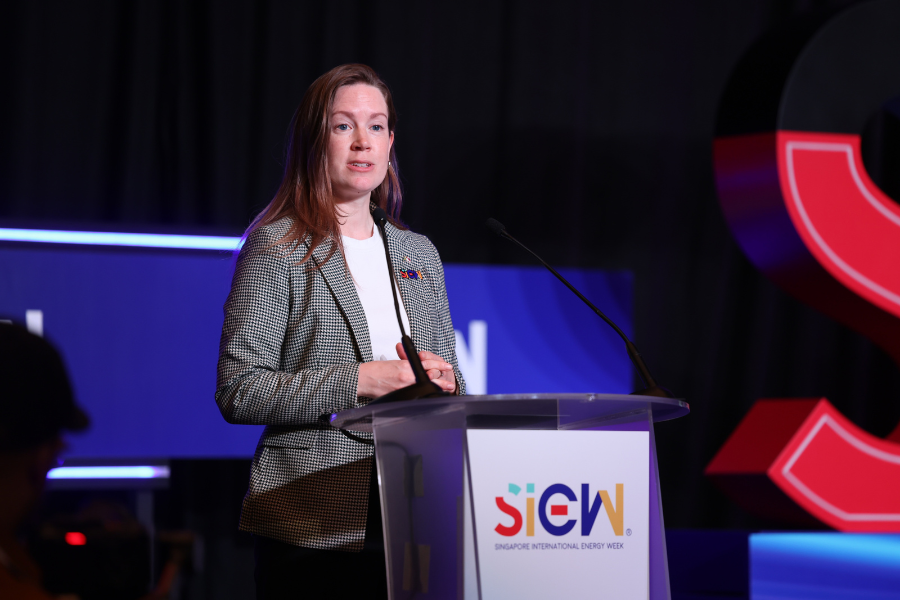
Helena Bernland, Senior Business Developer for International Markets at the Swedish Energy Agency, presented the keynote, Spotlighting Sweden's Energy Sector.
Mr Puah opened the forum by highlighting the growing bilateral energy partnership since the signing of a Memorandum of Understanding on Energy Cooperation in November 2024. During Singapore President Tharman Shanmugaratnam's state visit to Sweden in October 2026, both countries reaffirmed their commitment to deepening energy cooperation.
Building capabilities for emerging energy technologies
Mr Puah also identified opportunities for closer collaboration on emerging technologies. These included hydrogen, ammonia and nuclear energy. He highlighted Singapore's recent announcement of three nuclear manpower development schemes. These aim to build local expertise in independently assessing the suitability of advanced nuclear technologies for Singapore.
Beyond nuclear energy, he noted Singapore's newly launched funding initiatives for power decarbonisation, grid technologies and energy storage. He emphasised the need for smarter, more flexible and resilient grids to accommodate more renewable energy and rising electricity demand.
These areas of cooperation also reflect the complementary strengths highlighted by H.E. Mr Sjöberg. He noted that Sweden's engineering expertise and experience in nuclear and renewable energy could complement Singapore's ability to connect capital, technologies and markets across Southeast Asia.
He cited Siemens Energy and Keppel as an example of industrial collaboration. The companies had previously announced their intention to work towards developing a full-scale direct ammonia combustion power plant.
Strengthening regional energy interconnectivity
Regional power integration emerged as another key opportunity for Singapore–Sweden collaboration.
Mr Puah highlighted the ASEAN Power Grid's potential to strengthen regional energy security, enable cross-border electricity trade and facilitate greater renewable energy integration.
H.E. Mr Sjöberg pointed to Sweden's experience in Nordic electricity market integration, high-voltage direct current (HVDC) technology and submarine power cables. He expressed Sweden's willingness to share its technological, regulatory and policy experience as ASEAN advances regional electricity interconnectivity.
With Singapore preparing to assume the ASEAN chairmanship in 2027, Mr Puah welcomed contributions from Swedish companies and institutions to regional interconnectivity efforts.
Sweden's approach to integrated energy planning
Ms Bernland's keynote highlighted Sweden's experience in developing an almost fossil-free electricity system. She outlined the role of sustained investment and coordinated energy planning in supporting this transition. Almost two-thirds of Sweden's total energy use comes from renewable sources, while its electricity generation is almost entirely fossil-free.
This progress has been supported by investments in hydropower, nuclear energy and wind power, alongside long-term policy measures and research investment.
Ms Bernland highlighted Sweden's carbon tax, introduced in 1991, and emissions trading as important measures that encouraged innovation, efficiency and investment in emerging technologies.
Despite this progress, Sweden faces rising electricity demand. According to Ms Bernland, the country will need to more than double its electricity generation over the coming decades to support the electrification of transport and industry. Meeting this challenge, she explained, requires integrated planning across electricity demand, generation, transmission and storage. Her remarks underscored the importance of coordinating these elements as electricity systems expand to meet future needs.
Bringing Swedish innovation to Southeast Asia
Turning to the practical application of energy innovation, Ms Bernland outlined the Swedish Energy Agency's role in supporting energy innovation. The Agency also helps connect Swedish clean technology companies with commercial opportunities in Southeast Asia.
The Business Accelerator Programme Southeast Asia (BAPSEA) was established by the Swedish Energy Agency and Business Sweden. Through the programme, participating companies receive market-entry support, business matchmaking opportunities and assistance with regional delegation activities.
Now in its fourth year, the programme supports Swedish companies seeking to enter Southeast Asian markets. Singapore has been identified as a key market.
Singapore and Sweden have opportunities to deepen cooperation in emerging energy technologies, capability development, regional power interconnectivity and commercial innovation.
Both countries' complementary strengths and existing bilateral ties provide a foundation for practical partnerships that could support Singapore's energy transition and ASEAN's growing energy needs.
Stay tuned as the conversation evolves throughout the day. Follow @SIEW_sg on Telegram and X (formerly Twitter) for key insights and the latest updates.