Advancing small modular reactors (SMRs) towards commercial deployment will require more than technological innovation. Manufacturing capabilities, reliable supply chains, regulatory coordination and viable commercial models will be equally important.
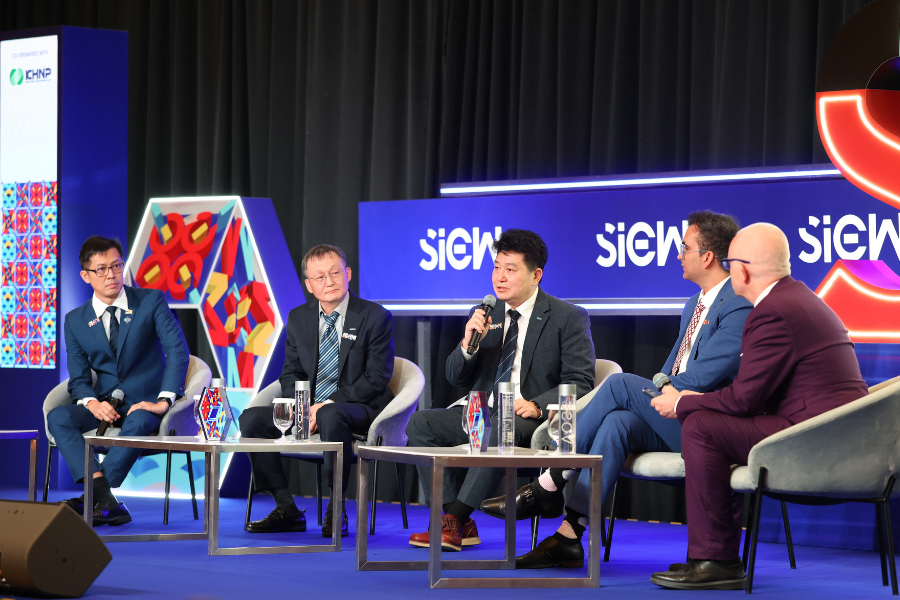
Spotlight Korea Forum Session 2 featured a panel discussion examining the capabilities needed to support SMR deployment and opportunities for Singapore's industrial sector. The discussion was moderated by Dr Jonathan Cobb, Senior Programme Lead, Climate, World Nuclear Association (WNA).
Expanding industrial opportunities beyond electricity generation
Chia Meng Hwee, Director, Nuclear Development Department, Energy Market Authority (EMA) of Singapore, highlighted electricity generation as the primary consideration in Singapore's assessment of nuclear energy, given rising electricity demand and the need to decarbonise.
However, should nuclear energy prove feasible for Singapore, other applications could be explored over the longer term. These include using heat from high-temperature gas-cooled reactors for petrochemical facilities, as well as heat from light-water reactors for desalination.
Mr Chia also highlighted opportunities for Singaporean companies to participate in international nuclear supply chains, regardless of whether Singapore eventually deploys nuclear energy domestically.
Drawing a comparison with the aviation industry, he explained that nuclear power plants require long-term servicing throughout their operational lives. Beyond initial construction, this creates potential opportunities for companies supplying equipment, replacement parts, maintenance and other supporting services.
Priyank Srivastava, Energy Lawyer, Corporate and Energy Practices, Duane Morris & Selvam LLP, similarly encouraged industry stakeholders to consider the broader economic value of SMRs. Beyond electricity generation, he highlighted their potential to support hydrogen production, industrial heat and steam, with SMRs potentially serving as energy anchors for industrial parks.
Manufacturing and logistics will shape SMR deployment
While SMRs offer opportunities for modular construction, manufacturing and transporting their components will present practical challenges.
Tark Kyoung-yool, Director, Doosan Enerbility, identified reactor vessel manufacturing as a potential bottleneck in the development of innovative small modular reactors (i-SMRs).
Unlike conventional large nuclear power plants, where major components such as steam generators and reactor coolant pumps are manufactured separately and assembled on-site, the i-SMR design integrates several components into a single module.
Mr Tark explained that this integration increases the size and weight of the reactor vessel, creating challenges for manufacturing and transportation. Coastal construction sites may be able to receive large components directly by ship, while inland sites could require components to be separated into transportable sections, depending on the findings of route surveys.
Nevertheless, he expected modular construction to shorten on-site construction periods by reducing installation work, as well as the number of inspection and testing points required.
Commercial readiness requires proven and bankable projects
Beyond manufacturing capability, the transition from SMR development to commercial deployment will depend on whether projects can demonstrate technical maturity, reliable delivery and financial viability.
Kim Nam-gil, Director, Market Research Division, Korea Nuclear Association for International Cooperation (KNA), outlined four milestones for assessing commercial readiness.
First, reactor designs must demonstrate technological and regulatory maturity, supported by credible safety cases and clear approval pathways. Second, a viable first-of-a-kind project must have an identified customer, suitable financing and an organisation capable of delivering the plant.
Third, the industry must establish qualified and sustainable supply chains, with reliable material sources, suppliers capable of meeting applicable standards and long-term maintenance capabilities. Finally, SMR projects must demonstrate repeatable and bankable commercial models, supported by customers willing to purchase electricity at commercially viable prices.
Building on this, Mr Srivastava emphasised that regulatory coordination and contractual arrangements would be essential to attracting investment.
He explained that SMR projects could involve reactor design in one country, manufacturing in another and deployment in a third. This would require regulatory considerations to be coordinated across jurisdictions.
Given the substantial investment involved, appropriate offtake agreements and sustainable revenue models would also be necessary to support project bankability.
The discussion underscored that advancing SMRs towards commercial deployment will require industrial capabilities, regulatory frameworks and commercial arrangements to develop alongside reactor technology.