Companies use Renewable Energy Certificates (RECs)1 to substantiate their use of renewable electricity, for the purposes of reporting greenhouse gas emissions and meeting sustainability targets. To provide greater clarity on how the different types of RECs can be used to support claims of renewable energy usage, Enterprise Singapore (EnterpriseSG), through the Singapore Standards Council (SSC), together with the Ministry of Energy, Trade and Industry (METI) and the Energy Market Authority (EMA), have updated the Singapore Standard (SS) 673: Code of Practice for RECs.
The updated SS 673 specifies the types of RECs that can support claims of renewable electricity consumption in Singapore. In line with the amendments, companies making claims of renewable electricity usage should use RECs linked to renewable electricity supplied directly to Singapore's power grid. These include RECs from renewable electricity generated in Singapore, such as solar energy, as well as RECs from approved low-carbon electricity import projects.
RECs from other overseas renewable energy projects that do not supply electricity into Singapore may still be purchased to support renewable energy development and regional decarbonisation efforts – but should not be used to support claims of renewable electricity usage in Singapore. See Annex A for more details.
First launched in 2021, SS 673 provides a framework to improve the integrity of measurement, reporting and verification (MRV) requirements for the issuance and management of RECs. It supports the credible and consistent use of RECs among energy users by setting out good practices for REC transactions and claims.
The amendments to SS 673 were developed by a public-private Working Group appointed by the SSC and overseen by EnterpriseSG, comprising representatives from government agencies, industry associations, renewable energy market participants and corporate REC users. The amendments also underwent public consultation before being finalised. EnterpriseSG, through the SSC, will continue to work with industry stakeholders to review and enhance SS 673 as technologies, market practices and international standards evolve.
The list of amendments to SS 673 can be downloaded free of charge from the Singapore Standards e-shop. The updated 2026 edition of SS 673, which incorporates the amendments, can be purchased from mid-November onwards.
- END -
Annex A: Key amendments to SS 673
Annex B: Stakeholder Perspectives on Updated SS 673
For media queries, please contact:
Enterprise Singapore
Paige Lim
Senior Business Partner, Corporate Communications
Tel: +65 97368840
Email: Paige_LIM@enterprisesg.gov.sg
Energy Market Authority
Sikha Bagaria
Senior Manager, Corporate Communications
Tel: +65 97774790
Email: sikha_bagaria@ema.gov.sg
Ministry of Energy, Trade and Industry
Kok Yin Yin
Senior Assistant Director, Communications & Engagement
Tel: +65 9221 4839
Email: kok_yin_yin@meti.gov.sg
Annex A
Key amendments to SS 673: Code of Practice for Renewable Energy Certificates (RECs)
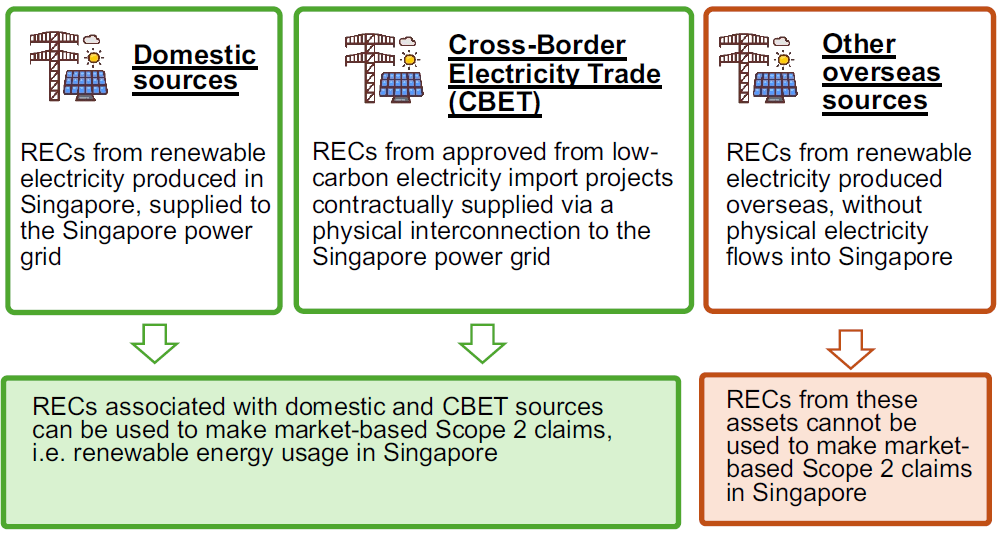
The updated SS 673 makes the distinction between (a) domestic RECs, (b) RECs from approved electricity import projects, referred to as cross-border electricity trade projects (CBET RECs), and (c) RECs from other overseas sources. Figure 1 summarises how each type of RECs may be used.
Under the updated SS 673, market-based Scope 2 claims2 should be supported by RECs linked to renewable electricity supplied to the Singapore power grid, i.e. domestic RECs and CBET RECs. CBET RECs are associated with overseas renewable energy installations that contractually supply electricity to Singapore via a physical interconnection to the Singapore power grid.
Other RECs from renewable energy projects that do not supply electricity into Singapore should not be used to support claims of renewable electricity use in Singapore. Such RECs may still be used for other purposes, such as demonstrating support for renewable energy development, rather than making market-based Scope 2 claims. Companies that wish to do so may consider purchasing RECs from within the UN geoscheme for Southeast Asia.
Figure 1. Types of RECs, and claims that can be credibly made for each REC type
2 Scope 2 emissions are indirect greenhouse gas emissions from the generation of purchased electricity consumed by an organisation. Market-based Scope 2 claims are claims that an organisation uses renewable electricity, supported by contractual instruments such as RECs.
Annex B
Stakeholder Perspectives on Updated SS 673
EMA and EnterpriseSG
- Mr Puah Kok Keong, Chief Executive of EMA said, “The amendments provide clearer guidance on the types of RECs that can support renewable electricity claims in Singapore, including RECs associated with domestic renewable energy sources and low-carbon electricity imports. This will help ensure that renewable electricity claims made in Singapore remain credible, transparent and consistent.”
- Ms Choy Sauw Kook, Director-General (Quality & Excellence) at EnterpriseSG, said, “As Singapore expands its access to renewable electricity, new supply sources and arrangements are emerging for businesses. The updated SS 673 responds to these developments by providing a robust framework for credible renewable electricity claims, enabling businesses to advance their decarbonisation efforts and contribute to Singapore’s transition to a low-carbon economy."
Members of Working Group for SS 673 on RECs
- Mr Christophe Inglin, Managing Director, Energetix Pte Ltd, and Chair of the Working Group said, “The Working Group brought together stakeholders from across the renewable energy value chain to address how different types of RECs should be used and communicated in Singapore. The updated SS 673 reflects consensus on how different types of RECs can support renewable electricity claims. It now distinguishes more clearly between RECs derived from renewable electricity that is physically supplied to Singapore’s grid and those that are not.”
- Ms Kavita Gandhi, Executive Director, Sustainable Energy Association of Singapore (SEAS) and member of Working Group said, "The updated standard gives the industry a common basis for understanding and using different types of RECs. This will help businesses make better-informed choices and support the continued growth of Singapore's renewable energy ecosystem."
- Mr Tai Jie Chuin, Group Environmental Manager, ST Telemedia Global Data Centres and member of Working Group said, “The amendments to SS 673 provide businesses with greater clarity and consistency in procuring renewable electricity and making credible, transparent claims. This is particularly important as demand for digital infrastructure grows and businesses work to reduce the carbon impact of their operations. Strengthening confidence in renewable electricity claims will support responsible growth and Singapore’s transition to a lower-carbon energy future.”