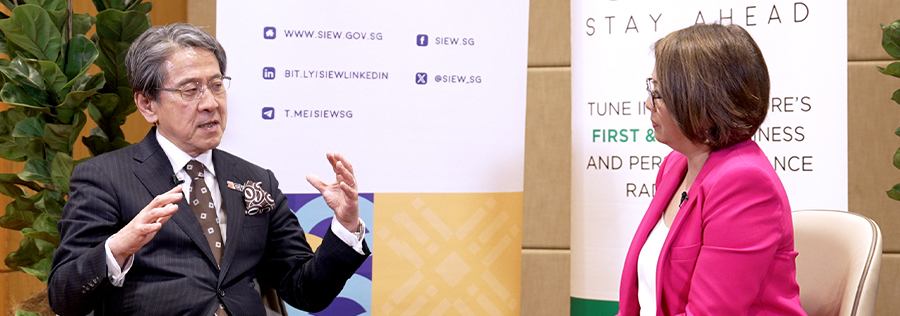
The energy transition won't succeed on ambition alone. It needs public finance to act first, and act boldly. In this episode, Tadashi Maeda, Managing Director, Chairman of the Board of Directors, Japan Bank for International Cooperation (JBIC), explains why public institutions must lead the way in de-risking new technologies and turning policy into investable action. Drawing from decades in public finance, he unpacks what realism looks like in practice. He also shares how Asia can start building systems today that are resilient, low-carbon, and ready for tomorrow.
Show Notes:
In this episode, we discuss…
- Why "one-size-fits-all" approaches fall short, and how Asia is charting its own path to net zero
- How public finance can de-risk first-mover projects and turn energy ambition into action
- Why energy transitions must account for infrastructure realities, and what Vietnam and Indonesia teach us
- What Japan's energy planning reveals about matching ambition with technology readiness
- How grid connectivity and Singapore's coordination role are accelerating ASEAN's energy integration
Key takeaways
01:20 | Energy transitions must reflect local context Mr Maeda stresses that each country's path to net zero must reflect its development stage. The Asia Zero Emission Community (AZEC) initiative supports dual goals: advancing decarbonisation while safeguarding energy security and growth. |
02:32 | Public finance can de-risk first-mover projects Amid rising global uncertainty, JBIC helps countries advance nationally tailored projects. Mr Maeda outlines how Japan's Green Transformation (GX) fund and bonds fill early-stage viability gaps, bringing policy and projects closer together. |
04:08 | Transitional fuels must be sequenced, not rushed Using Vietnam and Indonesia as examples, Mr Maeda underscores the importance of managing transitional infrastructure responsibly. He cautions that phasing out coal too quickly, especially in response to externally driven mandates, may not be practical for countries still building out essential capacity.
|
05:53 | New technologies must be matched with realistic timelines From small modular reactors (SMRs) to fusion, Mr Maeda highlights the need for realistic deployment planning. He advocates for interim solutions, such as gas turbines, while supporting innovation over the long term. |
07:43 | Hydrogen and ammonia show promise, but challenges remain Mr Maeda notes the technical and economic hurdles for hydrogen adoption, including energy density and transport complexity. He sees ammonia emerging as a plausible nearer-term option, especially in coal co-firing, though safety issues must be addressed. |
09:15 | Regional connectivity is now a top priority With the ASEAN Power Grid gaining momentum, JBIC is supporting infrastructure such as high-voltage direct current (HVDC) subsea cables. Mr Maeda highlights the return of Japanese technology players like Sumitomo Electric to the region. |
11:47 | Singapore's coordination role in regional integration Mr Maeda sees Singapore as a trusted, tech-savvy partner in ASEAN's energy future. He highlights its role in driving both industrial coordination and cross-border grid integration across Johor, Batam, and Bintan. |
14:57 | AZEC enables tailored, bilateral transition planning Unlike more centralised frameworks, AZEC takes a country-by-country approach through bilateral taskforces. Mr Maeda argues that this enables more realistic, responsive transition planning across Asia. |
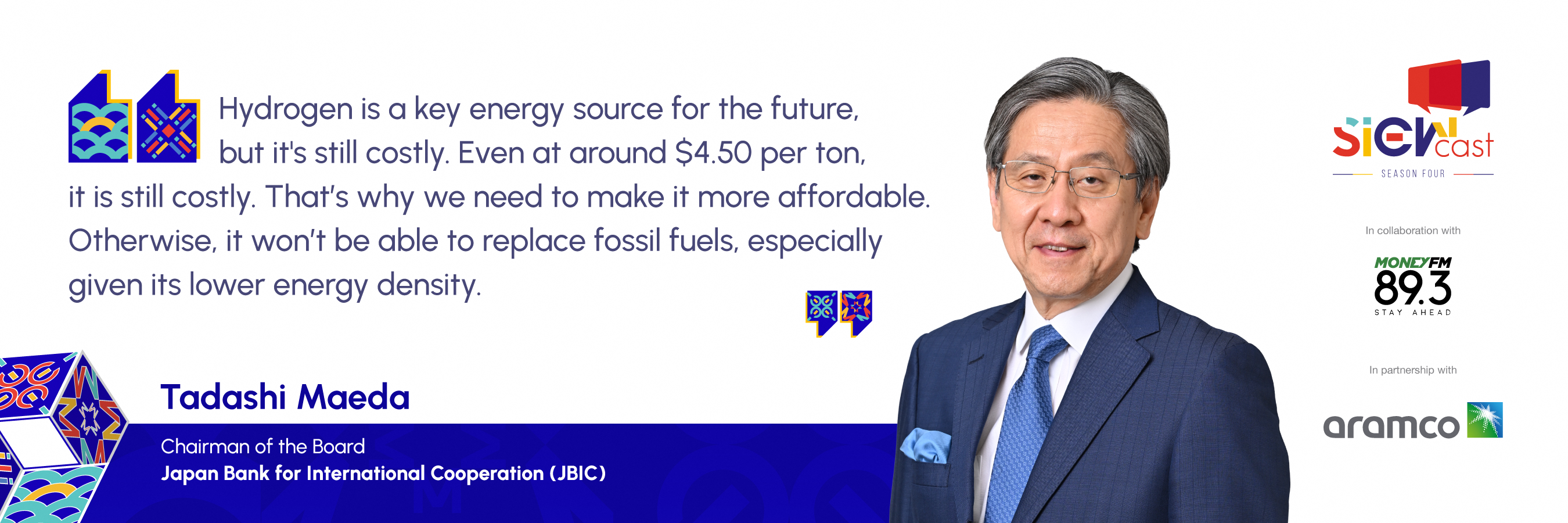
About our guest Tadashi Maeda is Chairman of the Board at the Japan Bank for International Cooperation (JBIC). He joined JBIC in 1982 and has held several key leadership roles over his career. These include Director-General of the Energy & Natural Resources Finance Department; Managing Executive Officer & Global Head of Infrastructure and Environment Finance Group; Senior Managing Director; CEO, Executive Managing Director; and Governor. He served as Special Adviser to the Cabinet of the Government of Japan from 2010 to 2012, and again from 2022 to 2024. He was also a member of the Steering Committee of the Nuclear Damage Liability Facilitation Fund from 2011 to 2013. From 2014 to 2017, he served on the Council of the International Institute for Strategic Studies (IISS). Since 2020, he has been a Global Advisory Board member of the Observer Research Foundation (ORF) in India. He holds a law degree from the University of Tokyo. |
Additional Resources
- Tadashi Maeda's bio
- Asia Zero Emission Community (AZEC) initiative
- Japan's Green Transformation (GX) fund and bonds
- High-voltage direct current (HVDC) technology
You can find the transcript of this episode here.
- Stay connected with the energy conversation.
Sign up for the SIEW newsletter for SIEWCast episodes, speaker insights, and event highlights delivered to your inbox. - Save the date and join us at SIEW 2026.
Be part of the Singapore International Energy Week (SIEW) from 26 - 30 October 2026. Register interest now at https://go.gov.sg/siewregint26.
This SIEWCast episode is brought to you by Singapore International Energy Week (SIEW) and MoneyFM 89.3, in partnership with Aramco.